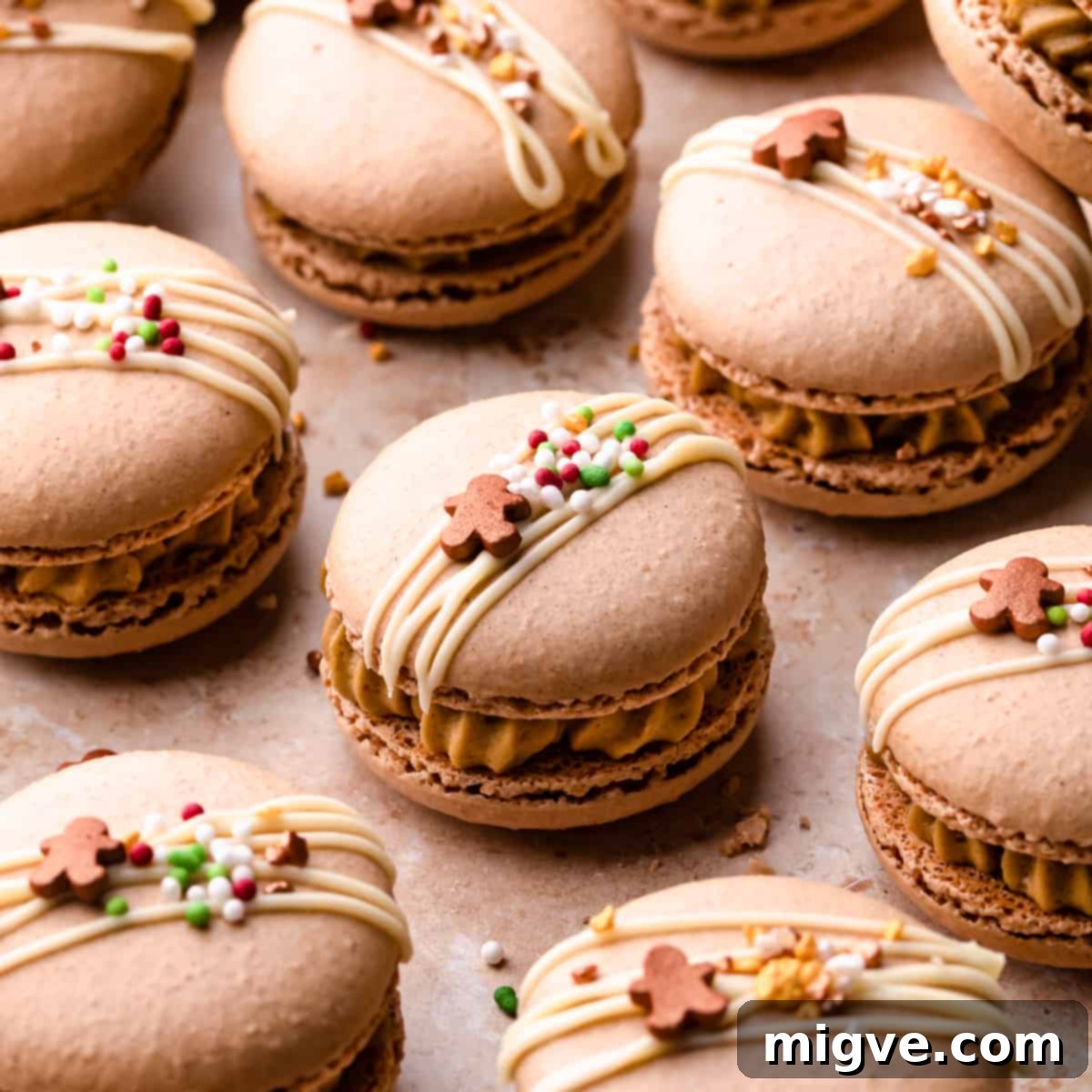
Gingerbread macarons are a truly enchanting holiday treat, perfectly blending the warmth of classic gingerbread with the delicate elegance of a French macaron. Imagine crispy, ginger-spiced shells giving way to a rich, creamy gingerbread buttercream filling, all crowned with a festive white chocolate drizzle and a scattering of vibrant sprinkles. These aren’t just any Christmas cookies; they’re an experience, delivering the unmistakable taste of traditional gingerbread in a sophisticated, bite-sized form that’s sure to impress.
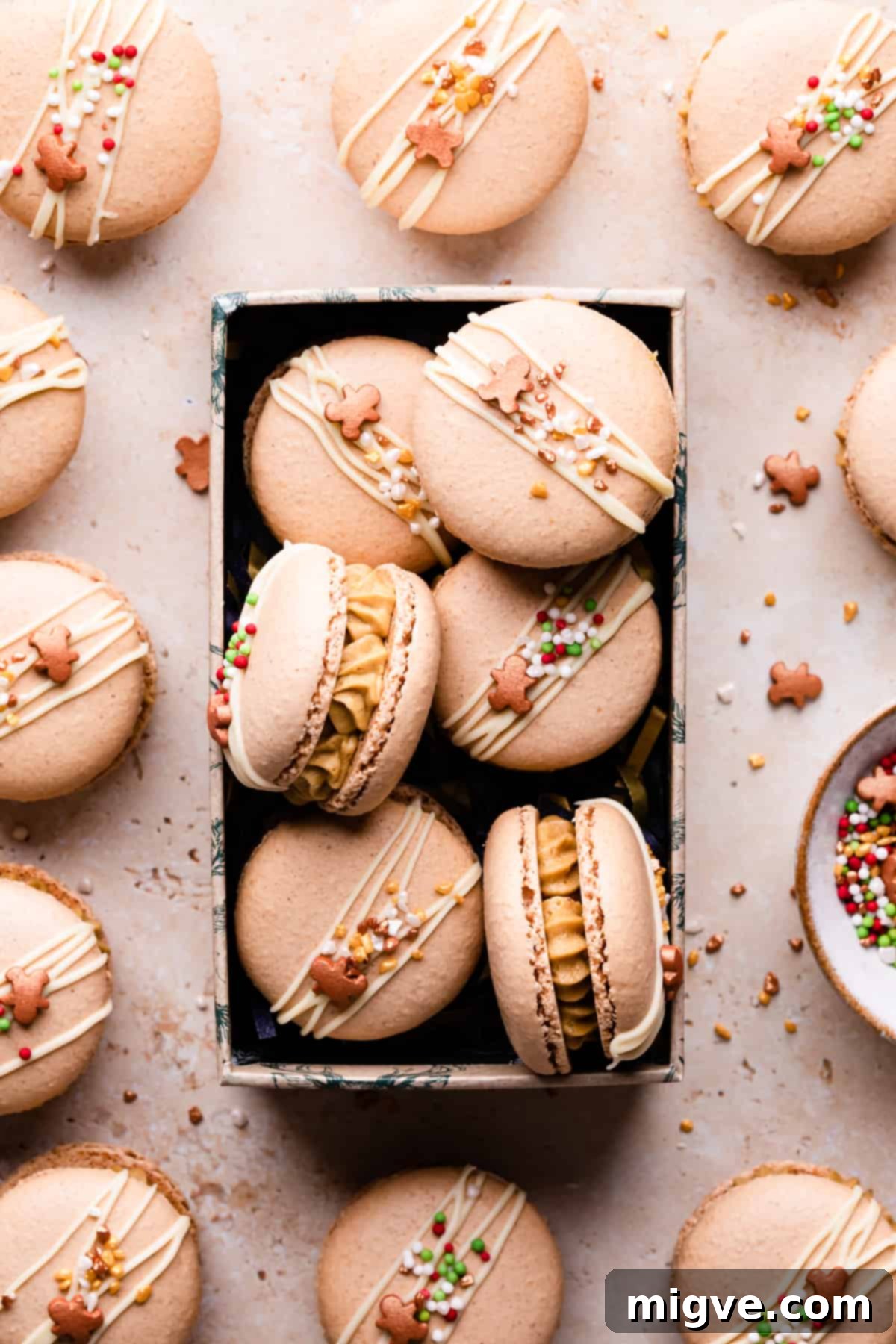
As the festive holiday season gently approaches, these exquisite gingerbread French macarons emerge as the quintessential treat, ideal for sharing cherished moments or presenting as thoughtful, homemade gifts to your nearest and dearest. The harmonious blend of warming spices—zesty ginger, fragrant cinnamon, and aromatic nutmeg—creates an irresistible flavor profile that perfectly encapsulates the spirit of winter holidays. Their elegant appearance and comforting taste make them an instant favorite.
These delightful gingerbread macarons are a fantastic addition to any holiday baking repertoire or cookie gift box. They pair beautifully with other seasonal favorites like our Salted Caramel Macarons, Soft Gingerbread Cookies, or classic Chocolate Thumbprint Cookies. Crafting these macarons adds a touch of gourmet flair to your festive spread, offering a unique and memorable dessert option that stands out from the crowd. Their intricate details and rich flavors transform ordinary holiday gatherings into extraordinary culinary celebrations.
Essential Ingredients for Perfect Gingerbread Macarons
Crafting these delectable ginger macarons requires a few fundamental ingredients, most of which are staples for any baker. However, mastering macarons often comes down to the quality and preparation of these components. Below, you’ll find detailed notes to guide you through selecting and preparing each ingredient for flawless results.
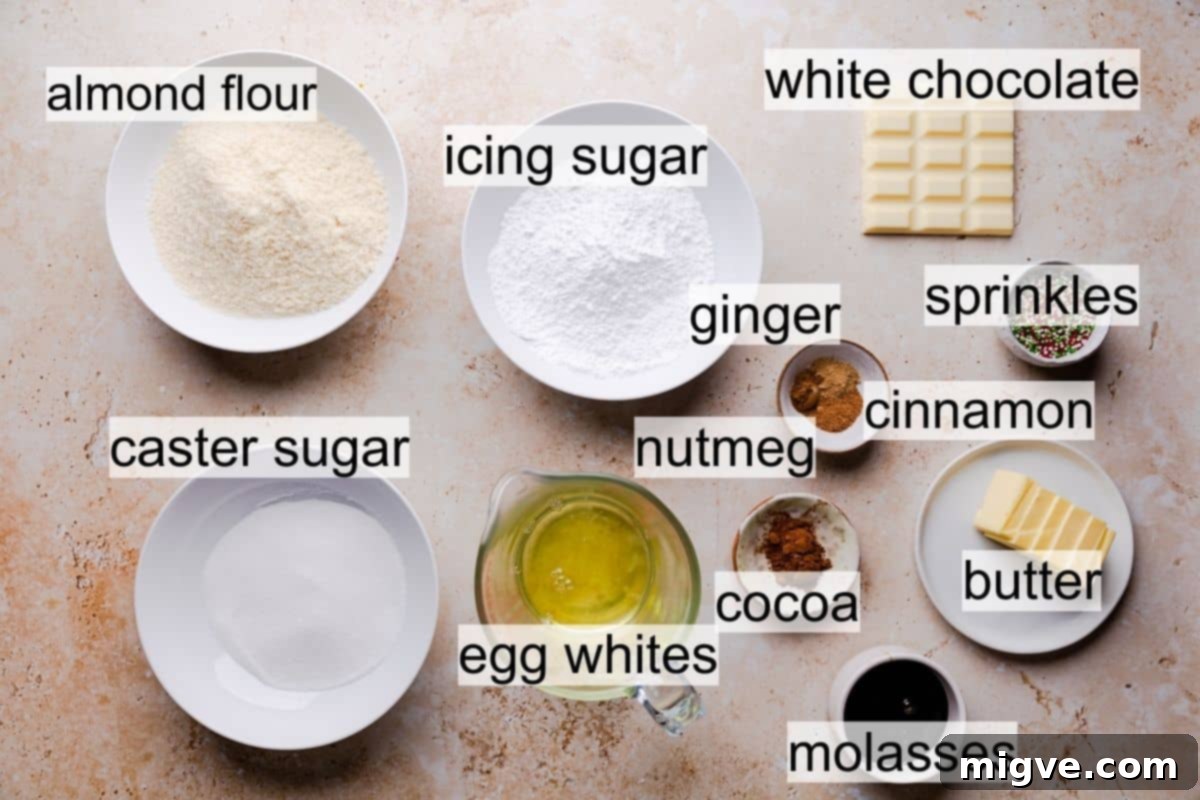
For the Crispy Macaron Shells
- Almond Flour: The foundation of a smooth macaron shell. It is paramount to use fine almond flour, not coarse almond meal. Almond flour is characterized by its off-white color and the absence of dark brown almond skin specks. In some regions, like the UK, it might be labeled as ‘ground almonds’. Sifting it thoroughly is crucial for achieving that signature smooth, delicate texture.
- Icing Sugar (Powdered Sugar): This provides sweetness and structure. Always ensure it’s sifted to eliminate any lumps, which could otherwise compromise the smooth surface of your macaron shells. Combining it with almond flour creates the ‘Tant pour Tant’ mixture essential for French macarons.
- Warming Spices: A festive blend of ground ginger, cinnamon, and nutmeg infuses the shells with that distinctive gingerbread flavor. Feel free to adjust the quantities or even introduce other warming spices like a pinch of cloves or allspice to tailor the flavor to your preference.
- Cocoa Powder: A small amount (typically 1 teaspoon) of unsweetened cocoa powder is included primarily for color, lending a beautiful, subtle gingerbread hue to the shells, rather than significantly altering the taste. Alternatively, a few drops of brown gel food coloring can achieve a similar visual effect without adding any cocoa flavor.
- Caster Sugar: This superfine granulated sugar is crucial for stabilizing the egg whites into a glossy, firm meringue. Its fine crystals dissolve quickly, preventing a grainy meringue.
- Egg Whites: Sourced from approximately three large eggs. Many experienced macaron bakers advocate for ‘aging’ egg whites by separating them and letting them sit in the fridge overnight or for up to 24 hours. This process slightly dehydrates them, which can improve meringue stability and shell consistency. Ensure they are at room temperature before whisking for optimal volume.
For the Luscious Gingerbread Buttercream Filling
- Unsalted Butter: Must be at room temperature, allowing it to whip up light and fluffy. Unsalted butter gives you control over the overall saltiness of the buttercream.
- Icing Sugar (Powdered Sugar): Sifted to ensure a smooth, lump-free buttercream. It sweetens and thickens the frosting.
- Molasses: A cornerstone ingredient for authentic gingerbread flavor. Molasses (or black treacle, if available) provides a distinctive bitter-sweet, rich, and dark caramel note that is indispensable to gingerbread.
- Ground Ginger, Cinnamon, and Nutmeg: These spices are added to the buttercream to amplify the wonderful, slightly spicy, and deeply aromatic gingerbread flavor throughout the macaron.
- Milk: An optional ingredient used sparingly (1-2 tablespoons) if your buttercream appears too dry or stiff. Any type of milk can be used to achieve the desired creamy consistency.
To elevate the visual appeal and add an extra layer of sweetness, white chocolate and festive sprinkles are highly recommended optional ingredients for decorating your gingerbread macarons. They add a celebratory touch perfect for the holidays.
For the complete recipe card with precise measurements and detailed steps, please scroll to the bottom of this post.
Step-by-Step Guide to Crafting Gingerbread Macarons
Making these delightful gingerbread macarons can be broken down into three manageable stages: preparing and baking the delicate macaron shells, crafting the gently spiced ginger buttercream filling, and finally, assembling and decorating these festive treats. Macarons are often considered temperamental, but by following these detailed instructions, you can achieve perfect results every time. Let’s walk through each step with process images to ensure your Christmas macarons are a complete success.
Mastering the Macaron Shells
Pro Tip: If you’re a visual learner, my Salted Caramel Macarons recipe includes a comprehensive video tutorial demonstrating the detailed steps for making macaron shells. Watching the macaron-making process can significantly simplify and clarify the technique!
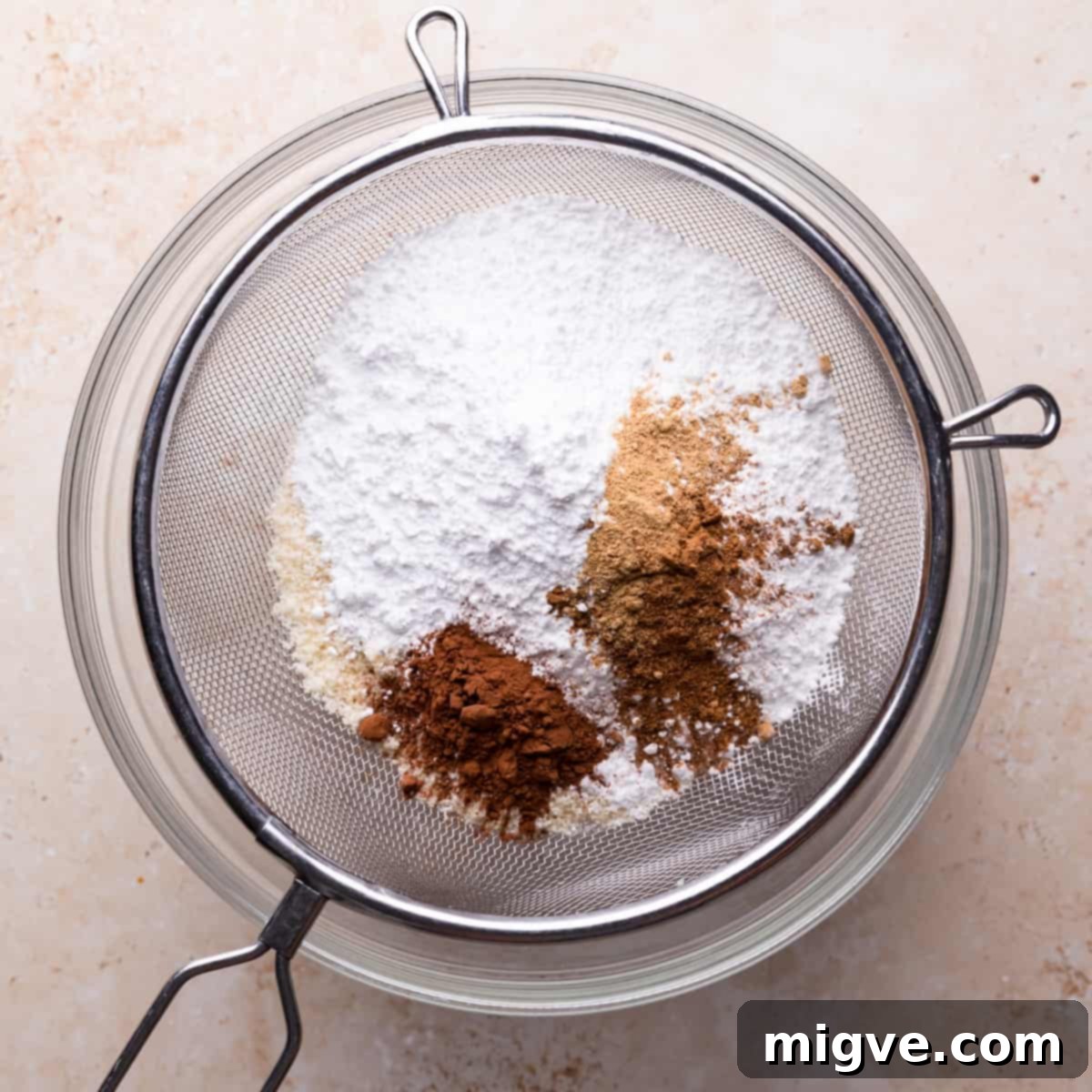
Begin by sifting your almond flour and icing sugar together thoroughly into a large bowl. This initial sifting helps eliminate larger almond bits and sugar lumps. Then, sift this mixture again, along with the ground ginger, cinnamon, nutmeg, and cocoa powder. This double sifting ensures the dry ingredients are perfectly combined and creates the finest powder for incredibly smooth macaron shells.
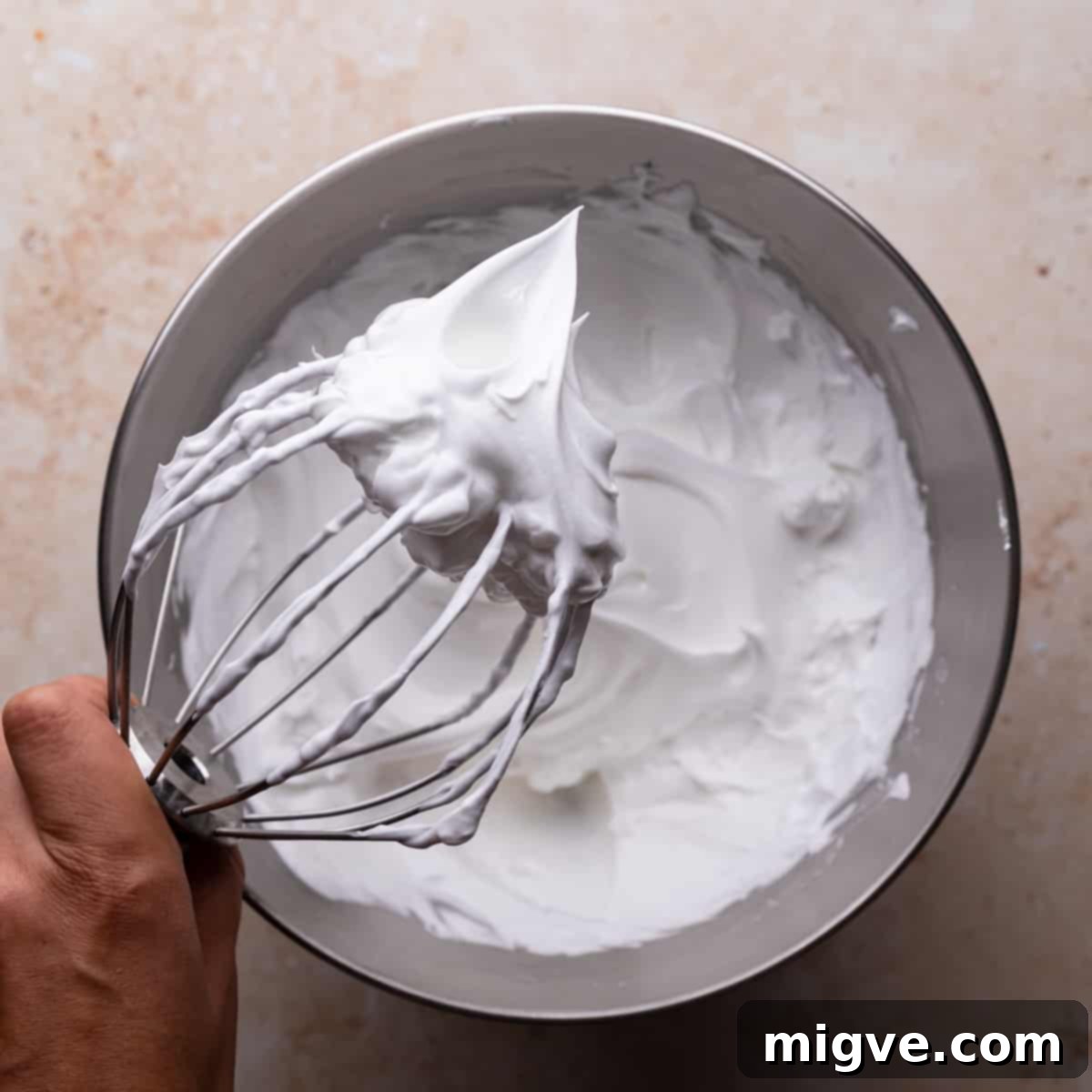
In a separate clean, dry mixing bowl (preferably glass or metal, wiped with lemon juice or vinegar to remove any grease), whisk the room-temperature egg whites until they reach soft, foamy peaks. Gradually, begin adding the caster sugar, one tablespoon at a time, continuously whisking. Continue beating until the meringue is glossy, firm, and forms stiff peaks that stand straight up when you lift the whisk, without curling over. This strong meringue is essential for macaron structure.
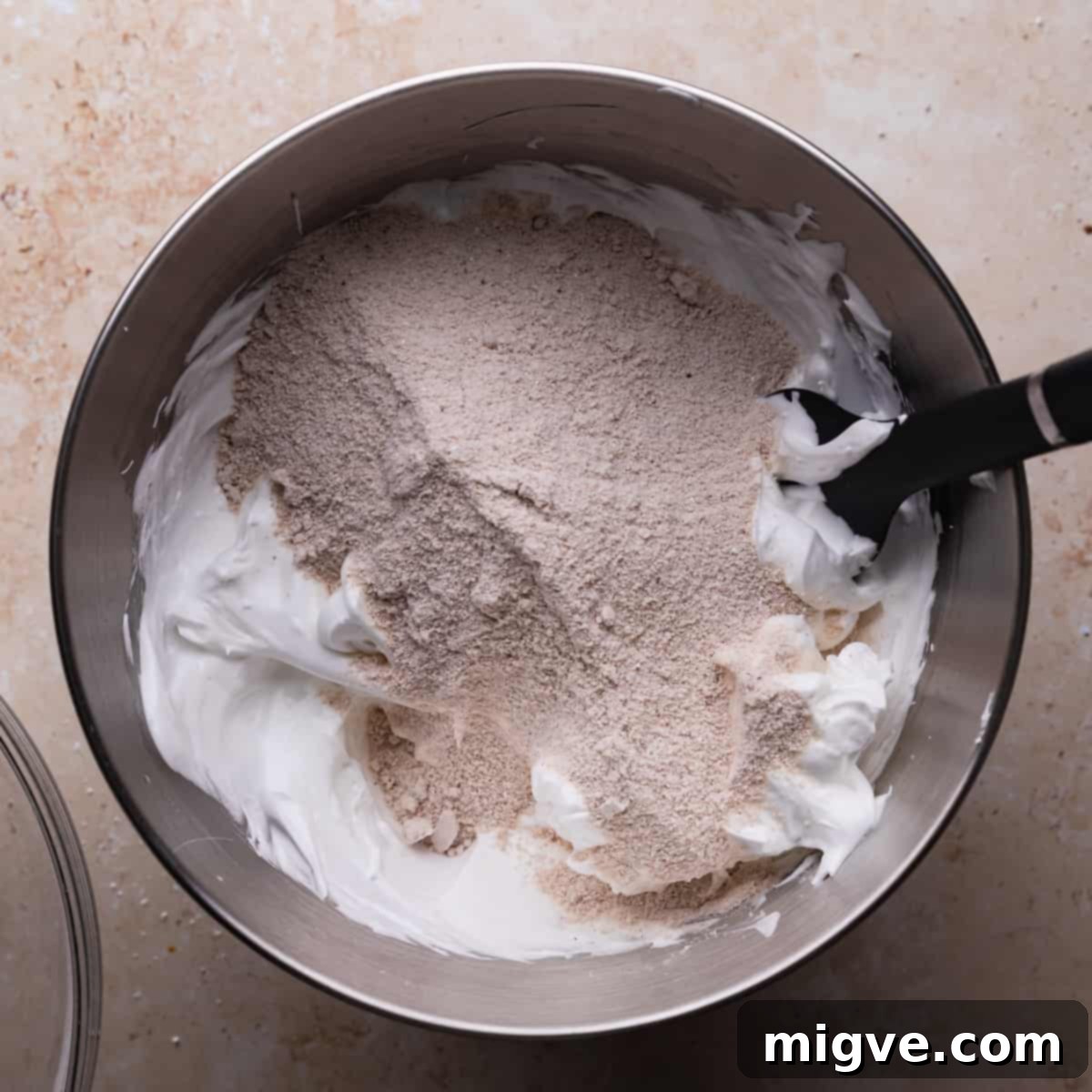
Now comes the crucial ‘macaronage’ stage. Using a rubber spatula or a sturdy metal spoon, gently fold half of the sifted almond flour and spice mixture into the meringue. Use a gentle, sweeping, figure-of-eight motion, pressing the spatula against the side of the bowl to deflate some air, but not too much. Once well combined, add the remaining half of the dry ingredients and continue to fold carefully until the batter reaches the perfect consistency.
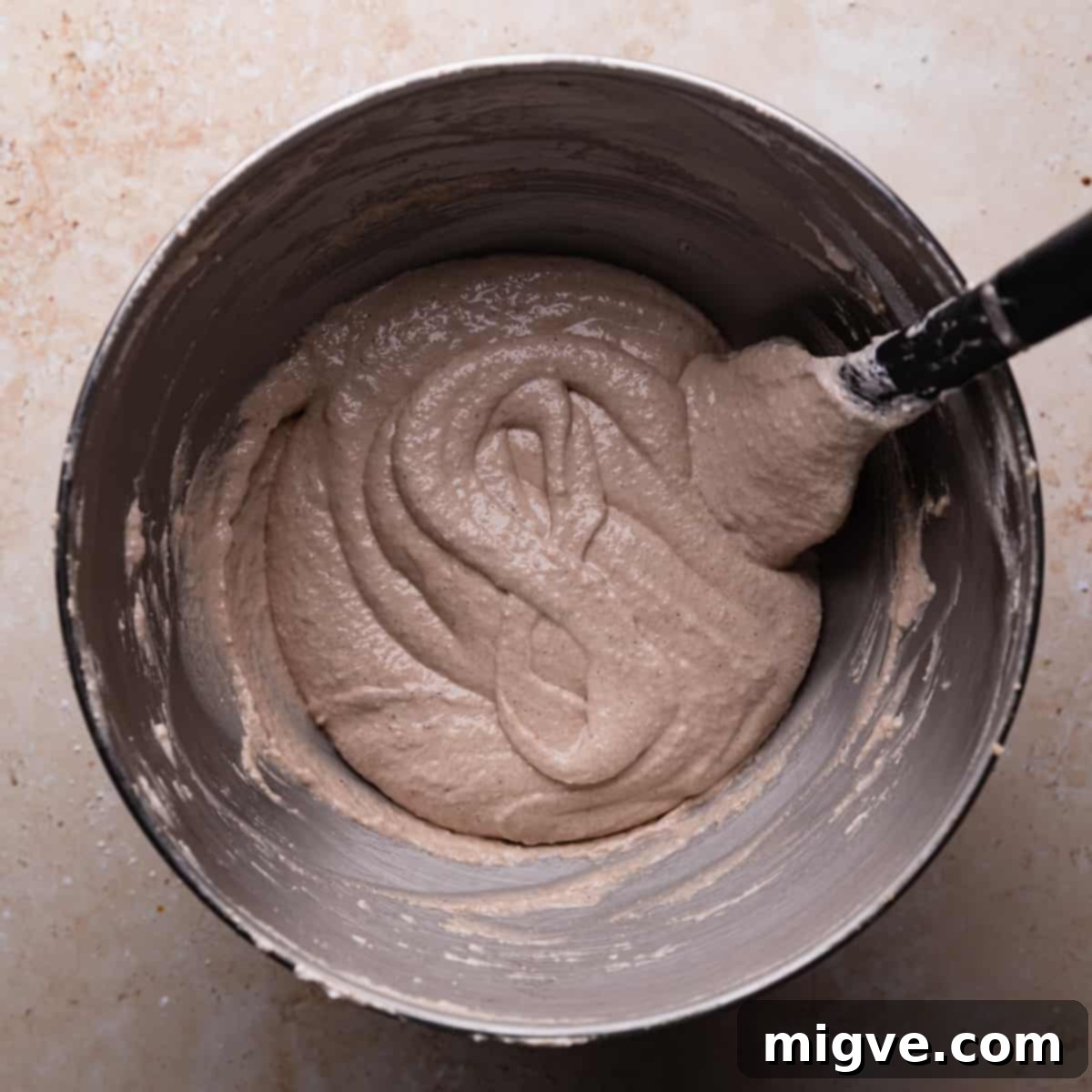
The batter should be shiny, glossy, and have a thick, flowing consistency, often described as ‘flowing lava’ or molten cake batter. To test for readiness, you should be able to draw a continuous figure ‘8’ with the batter falling from your spatula before it breaks. If it breaks too quickly, fold a few more times (3-4 at most), testing after each set of folds. Be careful not to overmix, as this will result in flat, spread-out shells.
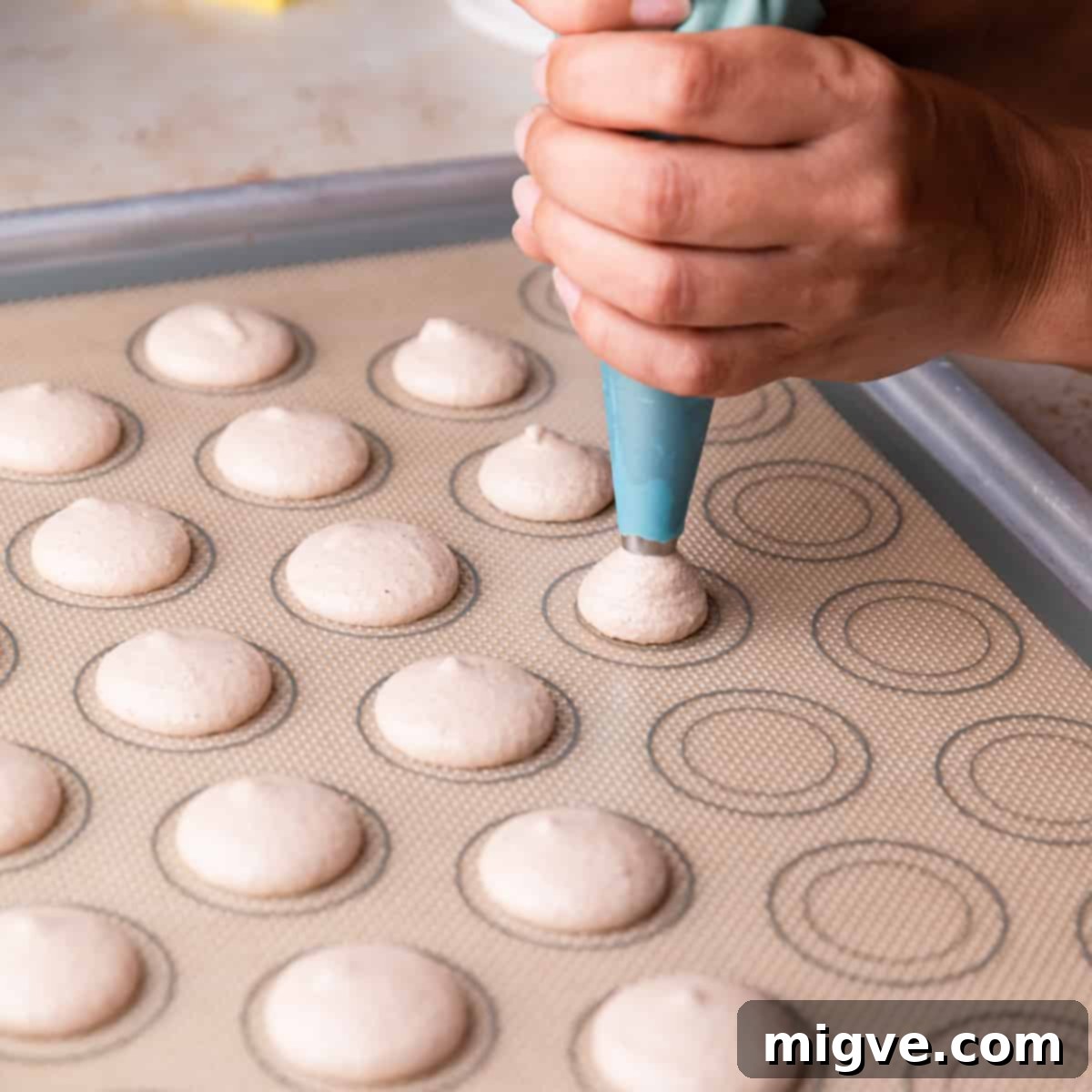
Transfer your perfectly mixed batter into a large piping bag fitted with a large, plain round nozzle (mine is typically 1 cm or 0.4 inches). Hold the piping bag vertically, about 1 cm above your prepared baking sheet (lined with a silicone macaron mat or parchment paper). Apply gentle, even pressure to pipe small, uniform circles, about 2.5 cm (1 inch) in diameter, for about 3-5 seconds. Release pressure and quickly twist and lift the bag for clean edges.
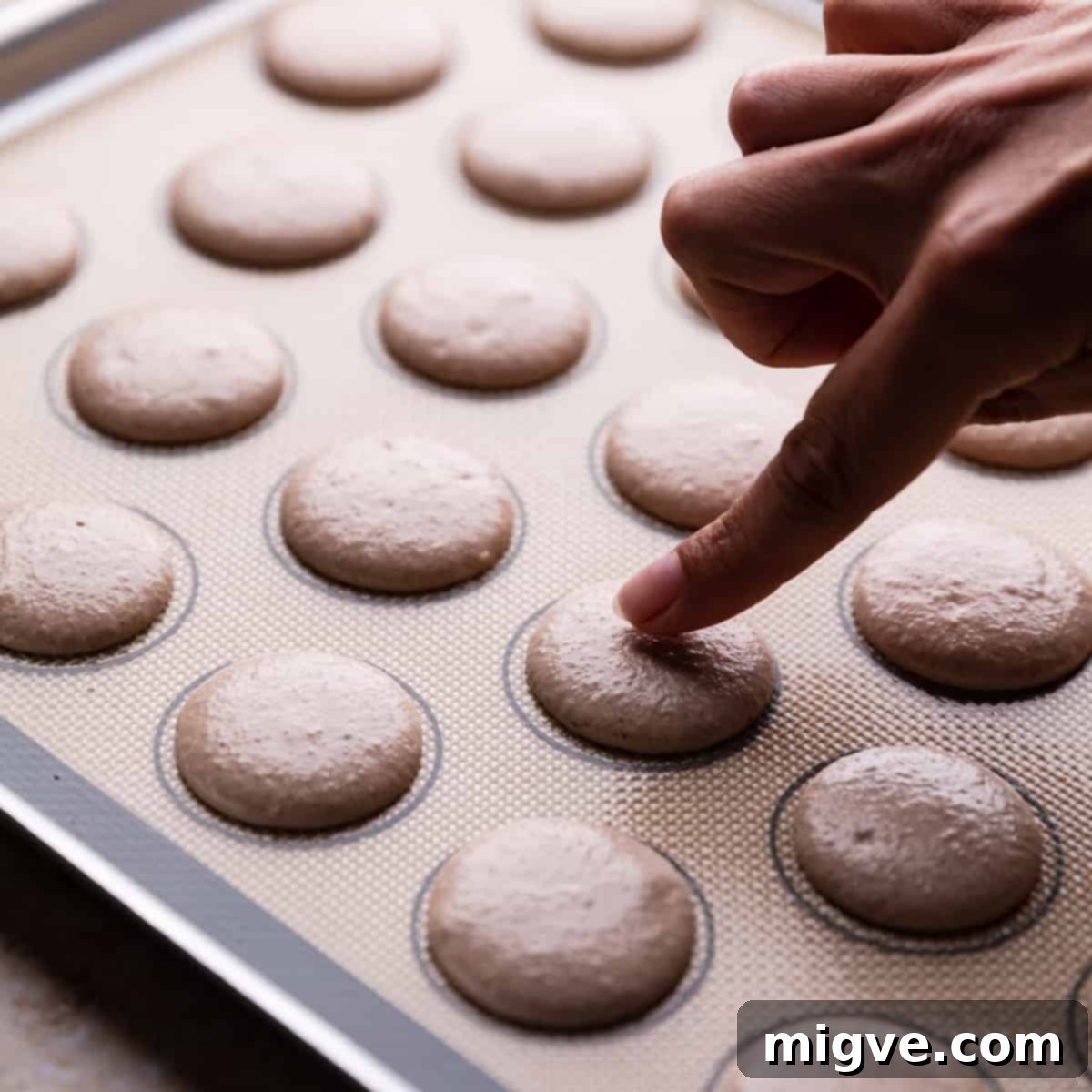
Once all macarons are piped, firmly tap each baking sheet against your kitchen counter 3-4 times. This helps to release any trapped air bubbles, preventing hollow shells. Use a toothpick to gently pop any remaining visible air bubbles on the surface. Now, let the macarons ‘rest’ or ‘dry’ at room temperature for 30 minutes to an hour, or until they develop a dry, non-sticky ‘skin’ on their surface. When lightly touched, they should feel completely dry to the fingertip. Preheat your oven to 160°C (320°F). Bake one tray at a time on the middle rack for 12-15 minutes.
Crucial Hint: After baking, allow the macarons to cool completely on their baking sheets. Patience is key here! They should peel off effortlessly from the silicone mat or baking paper when fully cooled. If they stick, they likely need more cooling time or perhaps a minute or two more in the oven on a subsequent batch.
Creating the Gingerbread Buttercream and Assembling Your Macarons
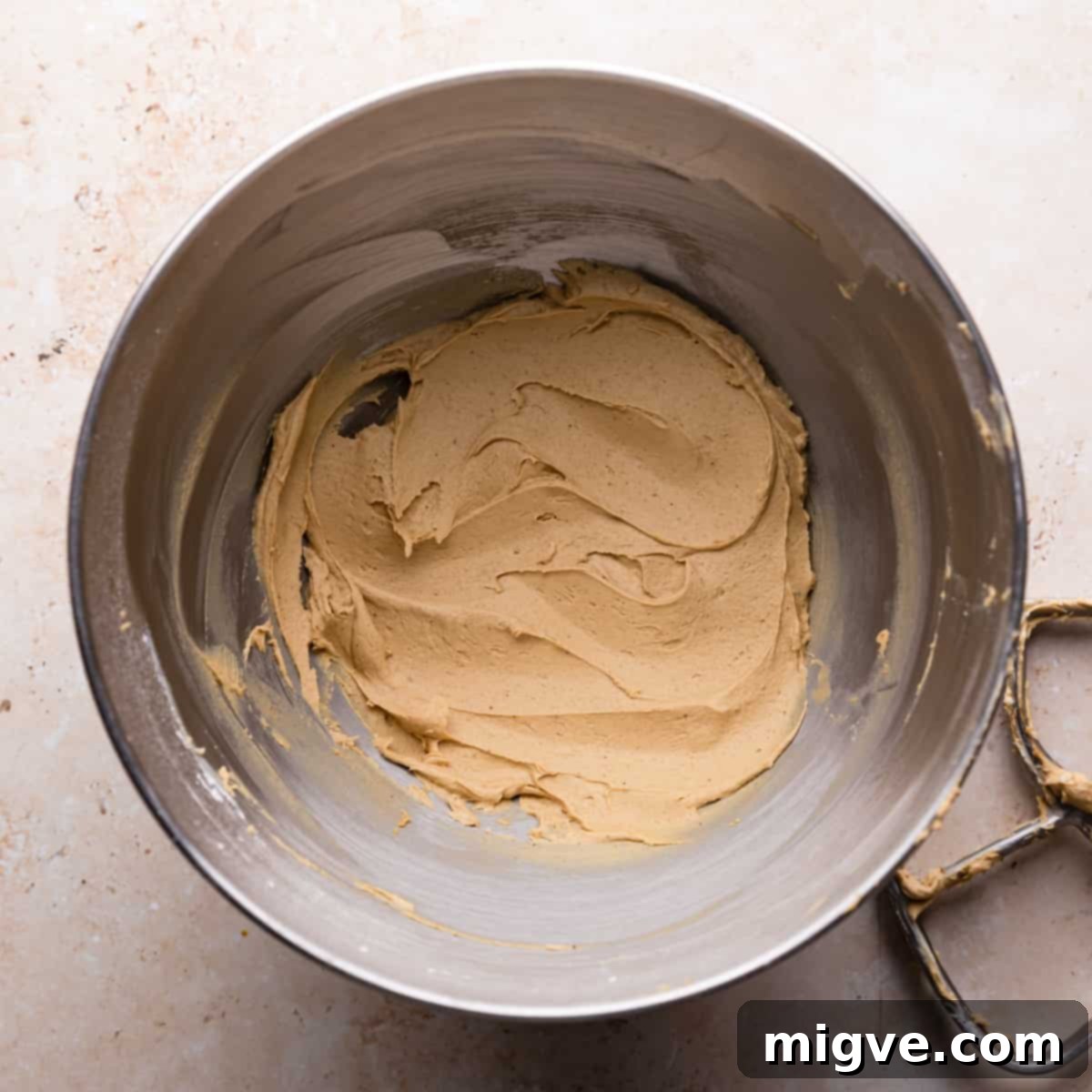
To make the luscious gingerbread buttercream, whip your softened, room-temperature unsalted butter in an electric mixer on medium speed for 2-3 minutes until it becomes light, pale, and fluffy. Gradually add the sifted icing sugar in two batches, mixing on low speed until fully incorporated. Then, stir in the molasses and all the gingerbread spices (ground ginger, cinnamon, and nutmeg). Mix again until everything is well combined and creamy.
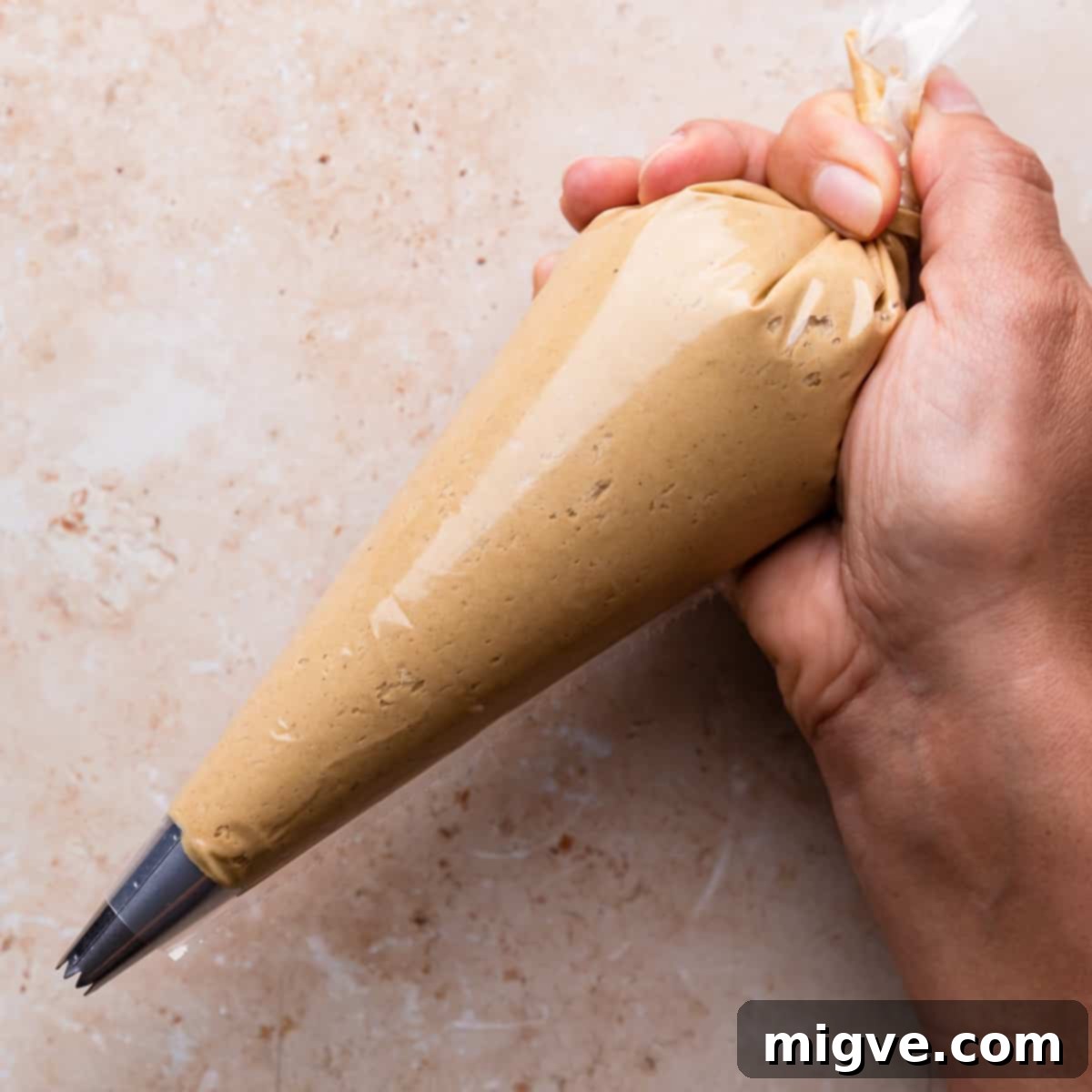
If your buttercream feels a bit too dry or stiff, add a tablespoon of milk at a time until you achieve a smooth, pipeable consistency. Avoid adding too much liquid, as this can make the buttercream runny. Once ready, transfer the gingerbread buttercream into a piping bag fitted with your desired nozzle. I prefer using a small French star piping tip for an elegant look, but a simple round tip works just as well.
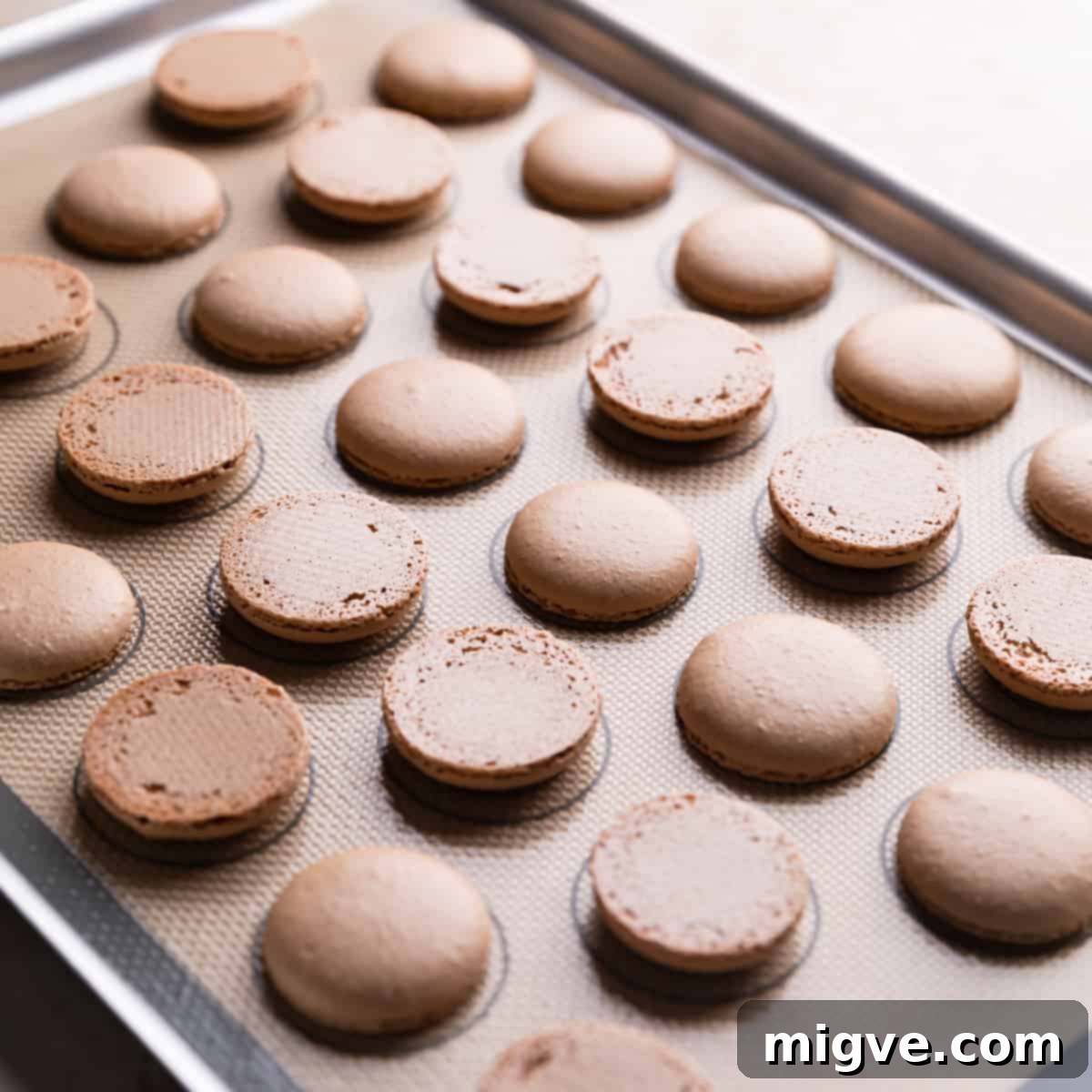
Before filling, carefully match up the baked macaron shells into pairs of similar size. This ensures your assembled macarons look uniform and professional. Place one half of each pair right-side up and turn the other half upside down. This preparation makes the filling process smoother and more efficient, particularly when working with delicate shells.
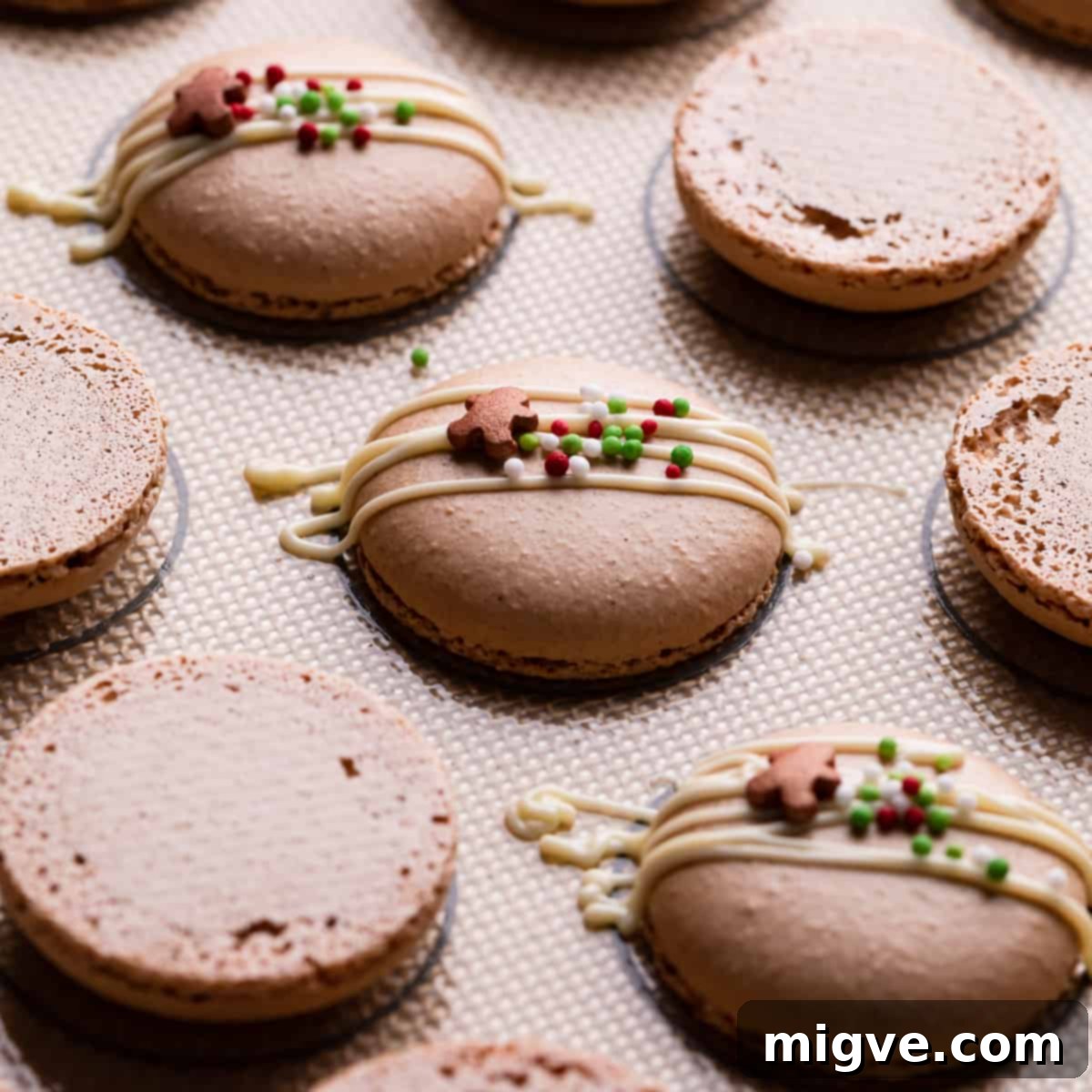
For an extra touch of festive charm and sweetness, melt some white chocolate and drizzle it decoratively over the top surface of half of your matched macaron shells. While the chocolate is still wet, liberally sprinkle with festive Christmas sprinkles. This step adds a beautiful visual appeal and a delightful textural contrast, making your gingerbread macarons truly stand out.
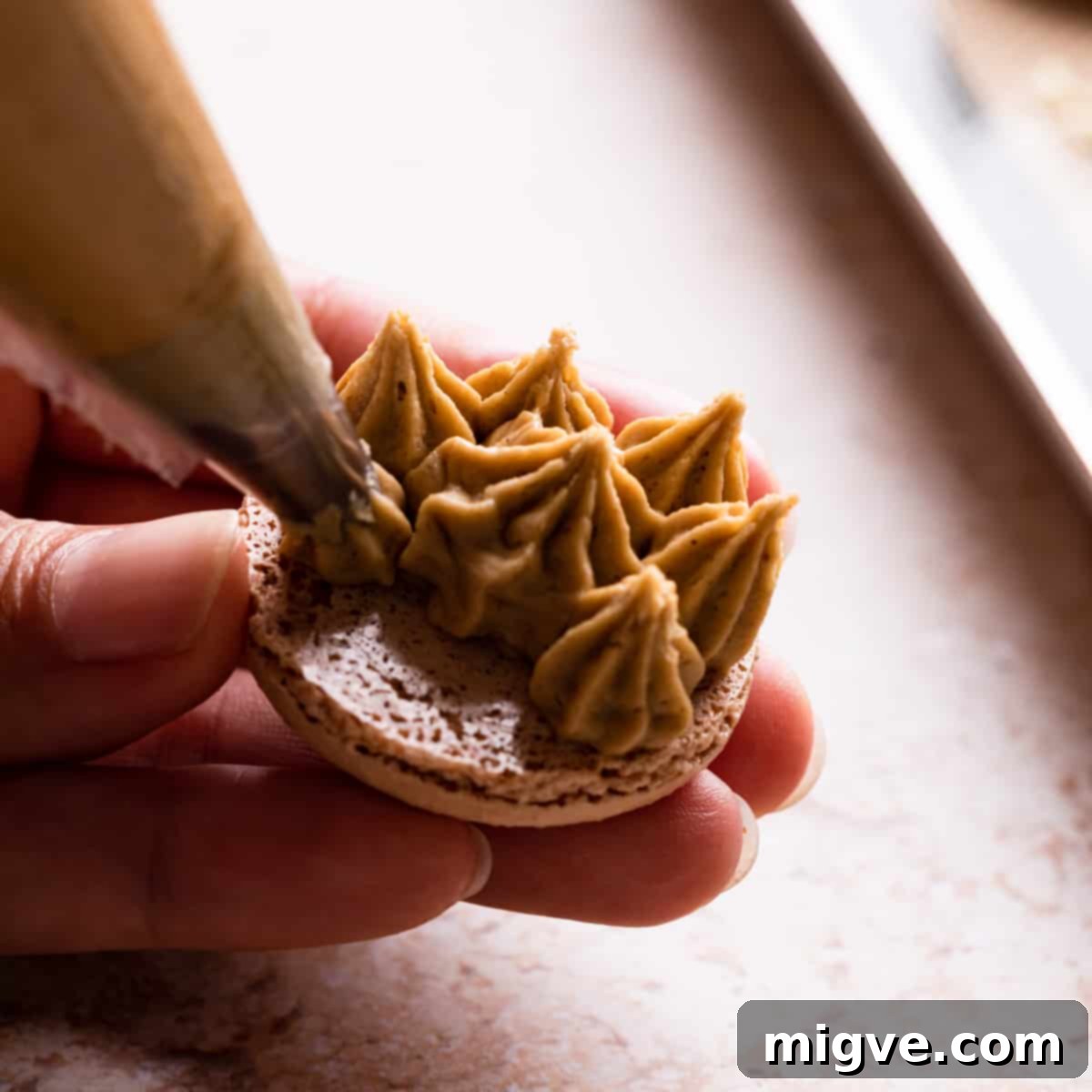
Pipe a generous dollop of the gingerbread buttercream onto the flat side of the remaining macaron shells (the ones without the white chocolate drizzle). Once filled, gently press the decorated shell on top, creating a beautiful sandwich. Be careful not to press too hard, as macaron shells are delicate and can easily crack.
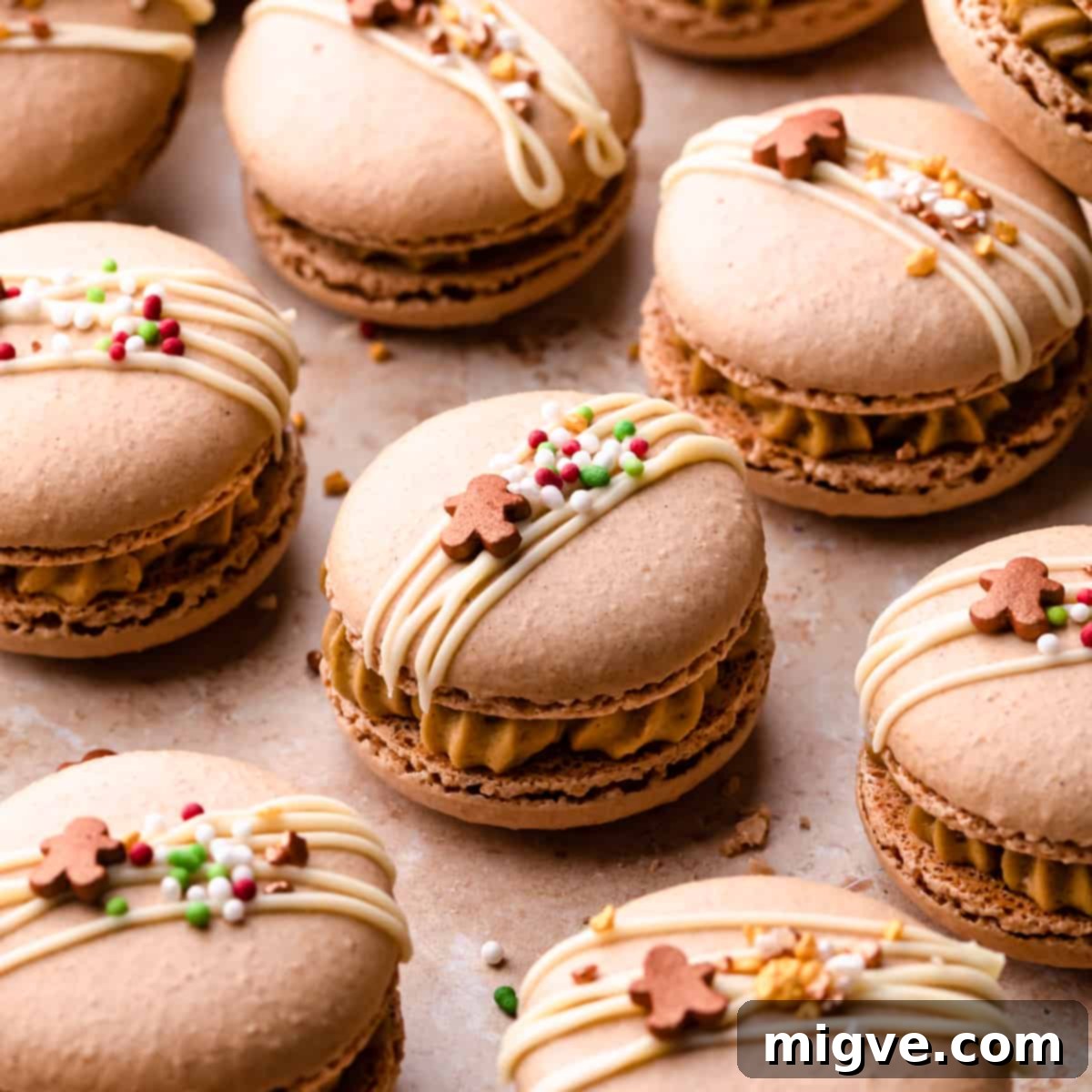
Once all your gingerbread macarons are assembled, carefully place them in an airtight container or box. Transfer them to the fridge for a crucial ‘maturation’ period of 12-24 hours. This allows the flavors to meld beautifully and the shells to soften slightly, achieving that signature chewy texture. For the absolute best taste and texture, remember to bring these delightful treats to room temperature before serving.
Serving Suggestion: For the most exquisite taste and melt-in-your-mouth texture, always allow these gingerbread macarons to come to room temperature before serving. I highly recommend removing them from the fridge approximately one hour before you plan to indulge.
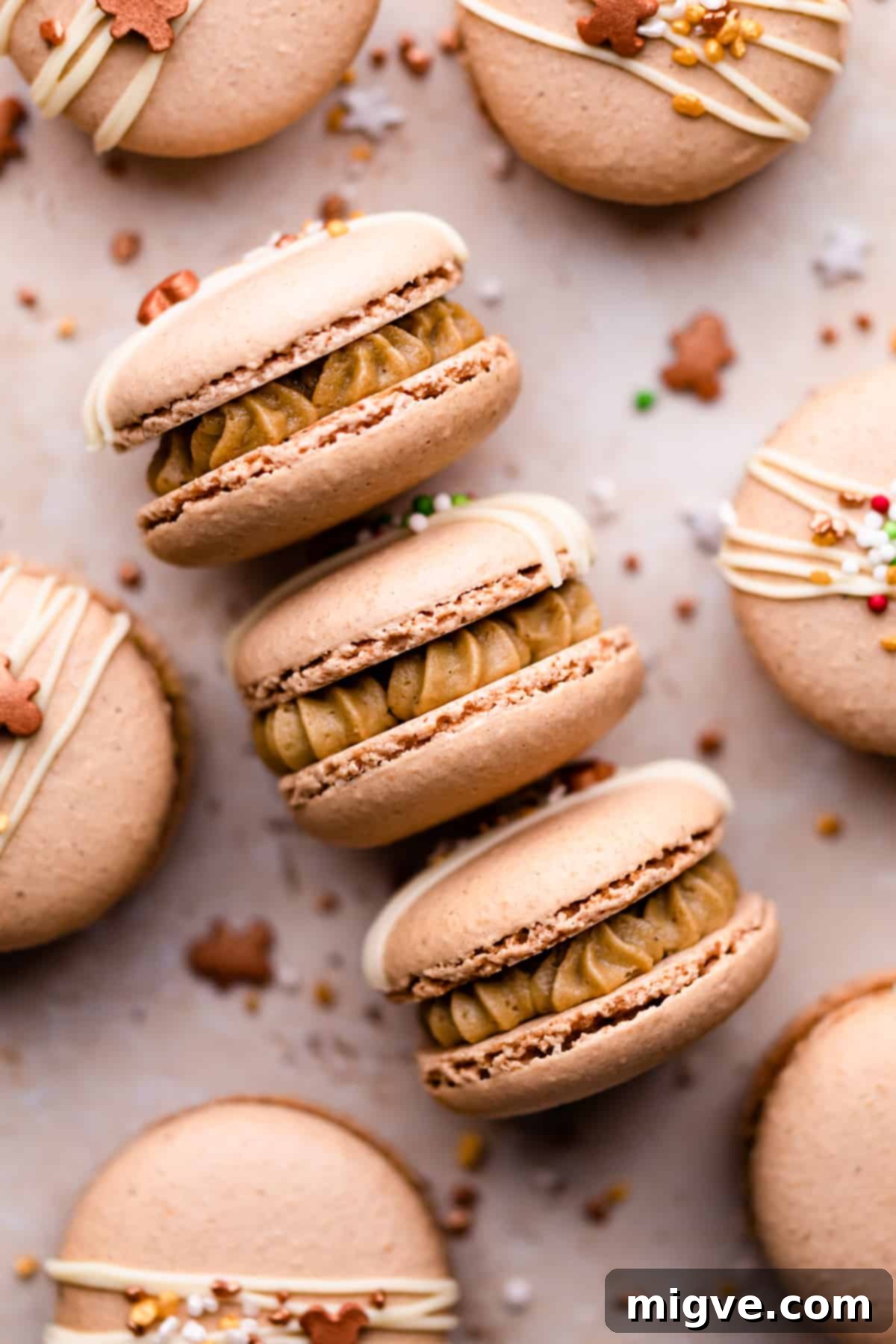
Creative Variations for Your Gingerbread Macarons
While our classic gingerbread macaron recipe is undoubtedly a crowd-pleaser, don’t hesitate to get creative and experiment with these delightful variations to personalize your holiday baking!
- Alternate Fillings: If you’re looking for a filling that is less sweet and offers a silky-smooth texture, consider a ginger Swiss meringue buttercream. To prepare it, simply follow the Swiss meringue buttercream recipe provided in my Salted Caramel Macarons post. Instead of incorporating salted caramel, infuse it with the rich flavors of molasses and your favorite gingerbread spices. This creates a more sophisticated and less intensely sweet flavor profile that beautifully complements the spiced shells.
- Decorating with Icing: Elevate the decoration of your macarons by swapping the melted white chocolate for a simple yet elegant glaze. A basic icing made from powdered sugar and a touch of milk can be drizzled, piped into delicate patterns, or even used to fully dip the macaron tops for a striking finish. For an even more personalized touch, use food coloring markers designed for confectionery to draw intricate designs, festive symbols, or names on your cooled macaron shells, making each one a miniature work of art.
Essential Equipment for Macaron Success
Achieving perfect macarons often relies heavily on having the right tools. While some steps can be managed with alternatives, investing in quality equipment significantly increases your chances of success with these delicate festive macarons. Below is a list of necessary equipment for this Christmas macaron recipe, along with explanations for their importance.
- Freestanding Mixer: A stand mixer is highly recommended for preparing the meringue. While a hand-held mixer can work, a stand mixer with a whisk attachment makes the process of beating egg whites to stiff peaks much quicker, easier, and more consistent, allowing you to focus on texture without arm fatigue.
- Digital Kitchen Scales: Precision is paramount in macaron baking. Weighing ingredients in grams is far more accurate than measuring in cups, which can vary wildly. Macarons are notoriously finicky, so exact measurements are crucial for the delicate balance of the batter. An accurate kitchen scale is your best friend here.
- Oven Thermometer: Home ovens are often inaccurate, frequently running hotter or cooler than their display indicates. Since baking temperature is a critical factor for macaron feet development and preventing hollow shells, an oven thermometer provides the true internal temperature, ensuring optimal baking conditions for consistent results.
- Large Baking Sheets: You will need at least two large, sturdy baking sheets. Heavy-duty trays that conduct heat evenly are best, as they help prevent burnt bottoms and ensure uniform baking across all shells.
- Silicone Mats or Parchment Paper: While optional, silicone macaron mats (often pre-printed with circles) are incredibly helpful for achieving uniformly sized shells. Plain silicone mats also work well. Alternatively, good quality parchment paper is a perfectly acceptable substitute. Avoid waxed paper, as it can stick.
- Piping Bags: Disposable or reusable piping bags are essential for neatly piping macaron batter and filling. I typically use a large piping bag for the macaron batter and a smaller one for the buttercream filling and decorating.
- Piping Nozzles: A large, plain round piping nozzle (with an opening of about 1 centimeter or 0.4 inches) is ideal for piping the macaron shells. This size allows for consistent and easy piping. For the buttercream, a small open French star nozzle adds a beautiful flourish, but you can also use the same plain round nozzle for the filling if you prefer.
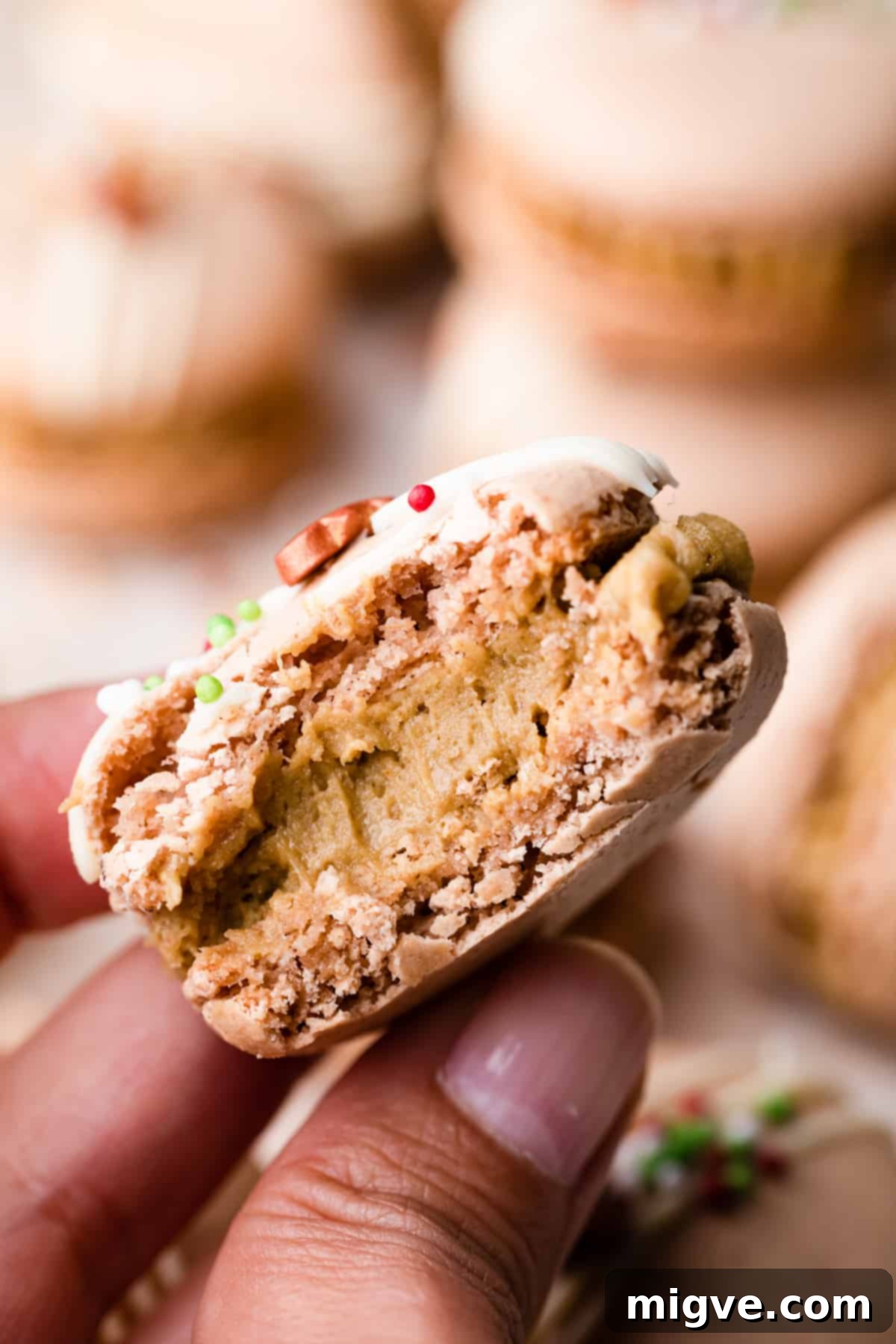
Storing Your Gingerbread Macarons for Optimal Freshness
Proper storage is essential to maintain the delicate texture and vibrant flavor of your gingerbread macarons. Follow these guidelines to ensure they remain delicious for as long as possible, whether you plan to enjoy them immediately or save them for later.
- Room Temperature Storage: Once assembled, gingerbread macarons can be stored in an airtight container at cool room temperature for up to 2 days. This is ideal if you plan to serve them within a short timeframe, allowing their flavors to continue to meld beautifully.
- Refrigerated Storage: For extended freshness, transfer your assembled macarons to an airtight container and store them in the refrigerator for up to 5 days. Keeping them airtight is crucial to prevent them from drying out or absorbing any unwanted odors from the fridge.
- Freezing Macaron Shells: Cooled macaron shells, prior to filling, can be frozen for up to one month. Arrange them in a single layer on a baking sheet to freeze solid, then transfer them to an airtight container or freezer bag, separating layers with parchment paper. Thaw at room temperature before filling.
- Freezing Assembled Macarons: Fully assembled gingerbread macarons can also be frozen for up to a month. Place them in an airtight freezer-safe container, ensuring they are not squished. Thaw them completely at room temperature for several hours before serving to restore their optimal texture.
- Gingerbread Buttercream Storage: The gingerbread buttercream filling can be prepared ahead of time and stored in an airtight container in the fridge for up to 1 week. Before using, allow it to come to room temperature and re-whip it briefly with an electric mixer until it’s smooth and fluffy again. This will ensure it’s easy to pipe and has a lovely consistency for your macarons.
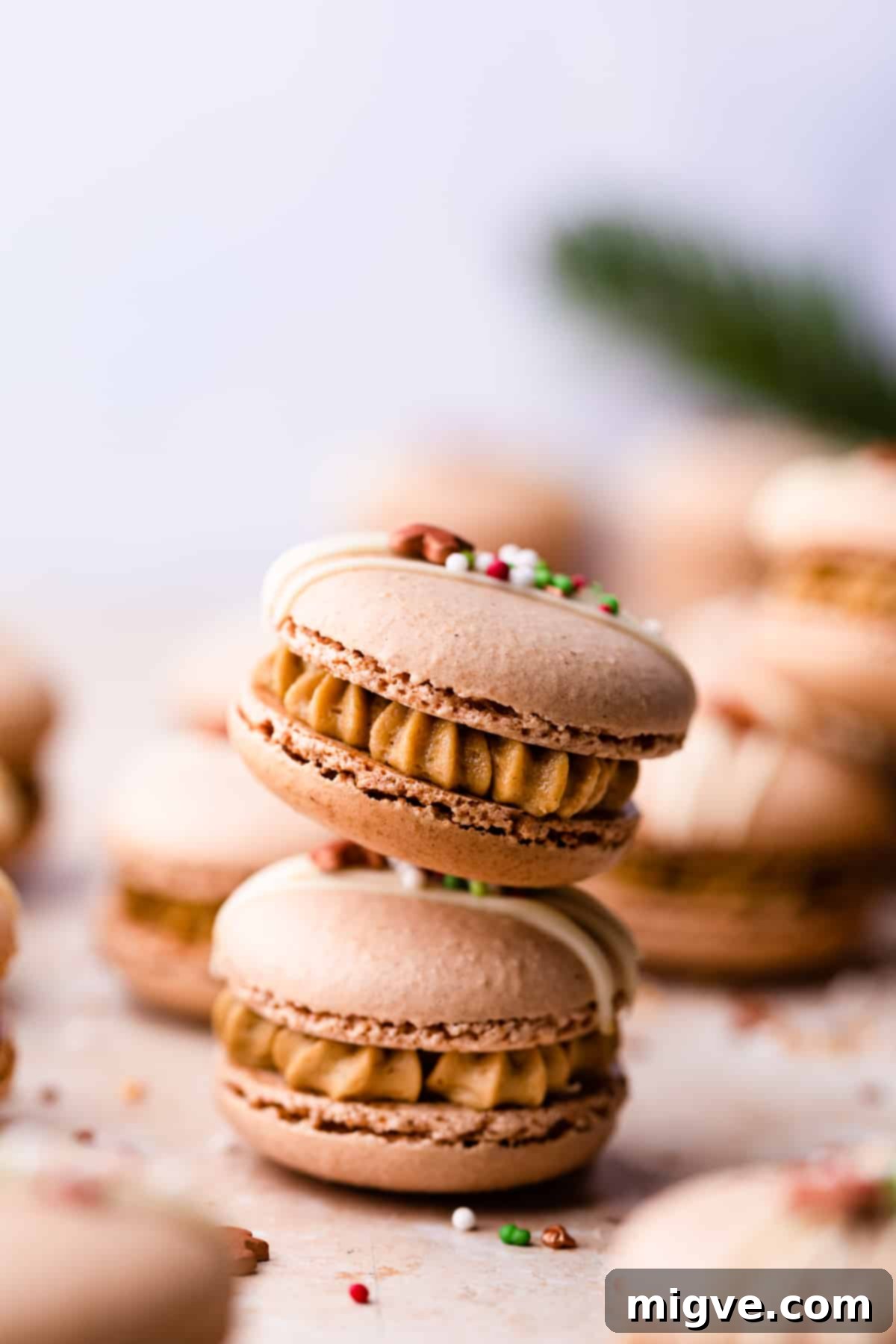
Top Tips for Macaron Perfection
Making macarons can be a rewarding experience, and these top tips are designed to help you achieve the best possible gingerbread macarons:
Preparation is Key: Before you even begin whisking, ensure you have everything meticulously prepared:
- Line your baking trays with baking paper or dedicated silicone macaron mats.
- Have your piping bags ready and fitted with the appropriate nozzles for both shells and filling.
- Crucially, wipe your mixing bowl and whisk attachment (for the meringue) with lemon juice or a tiny bit of vinegar. This degreases the equipment, which is vital for stable meringue formation.
- Measure all your ingredients precisely using a digital kitchen scale. Accuracy is non-negotiable for macarons.
Double Sifting for Smoothness: I strongly recommend sifting your icing sugar and almond flour together at least twice. Then, sift this mixture again with the gingerbread spices and cocoa powder. This extra step is paramount for removing any stubborn lumps and ensuring your macaron shells achieve that coveted, perfectly smooth surface texture.
Parchment Paper Alternative: If you don’t own silicone mats, don’t fret! Two sheets of good quality parchment paper will work perfectly. For uniform sizing, you can draw 2.5cm or 3cm (1-inch) round circles on the underside of the parchment paper using a cookie cutter as a guide. Remember to leave at least 2cm (0.8 inches) of space between each circle to prevent them from merging during baking.
Temperature Control: Macarons are sensitive to temperature. Ensure your egg whites are at room temperature before whisking. Also, remember to use an oven thermometer to verify your oven’s true temperature, as inconsistencies can lead to baking failures.
Don’t Rush the Rest: The resting period after piping is critical. This allows a ‘skin’ to form, which helps create the iconic ‘feet’ during baking and prevents cracking. Test gently with your finger; if it’s no longer sticky, they are ready.
Frequently Asked Questions About Gingerbread Macarons
Determining when macarons are perfectly baked is crucial. The simplest indicator is stability: gently try to wiggle a macaron shell on the baking sheet. If it doesn’t move or feels securely attached to its ‘feet’ (the ruffled base), it’s likely done. Additionally, well-baked macarons will often appear slightly darker and have fully formed, prominent feet. If they still feel jiggly or soft when gently nudged, they require a few more minutes in the oven. Underbaked macarons tend to stick to the mat and have a chewy, underdeveloped interior.
Hollow macarons are a common frustration for bakers and can be attributed to several factors, most notably incorrect macaronage (the folding stage) or issues with air bubbles. The batter might have been either under-mixed (too much air trapped) or over-mixed (too much air deflated, causing the batter to be too thin). Pay close attention to achieving the ‘flowing lava’ consistency during macaronage, stopping as soon as it’s reached. Furthermore, ensure you vigorously tap the baking sheets after piping to release trapped air, and use a toothpick to pop any visible surface bubbles. An inaccurate oven temperature or insufficient drying time can also contribute to hollow shells.
The absence of ‘feet’ – the signature ruffled edge at the base of the macaron shells – is typically a result of issues with meringue consistency, batter mixing, or oven temperature. Avoid over-beating your egg whites, as an overly stiff or dry meringue can hinder proper foot development. Similarly, over-mixing the macaron batter can lead to a runny consistency that prevents the feet from forming. Crucially, allow your piped macarons sufficient time to ‘rest’ and develop a dry skin before baking. If the skin isn’t properly formed, the steam won’t be able to escape correctly through the base, preventing the feet from lifting. Lastly, ensure your oven temperature is accurate (using an oven thermometer) and consistent, as an oven that’s too cool or too hot can also inhibit foot development.
While it might be tempting to double the recipe to produce a larger batch, macarons are very sensitive to ingredient proportions and mixing techniques. For the most consistent and successful results, I highly recommend making two separate batches rather than attempting to double this recipe. This approach allows you to maintain better control over the meringue and macaronage process, significantly reducing the risk of common macaron pitfalls.
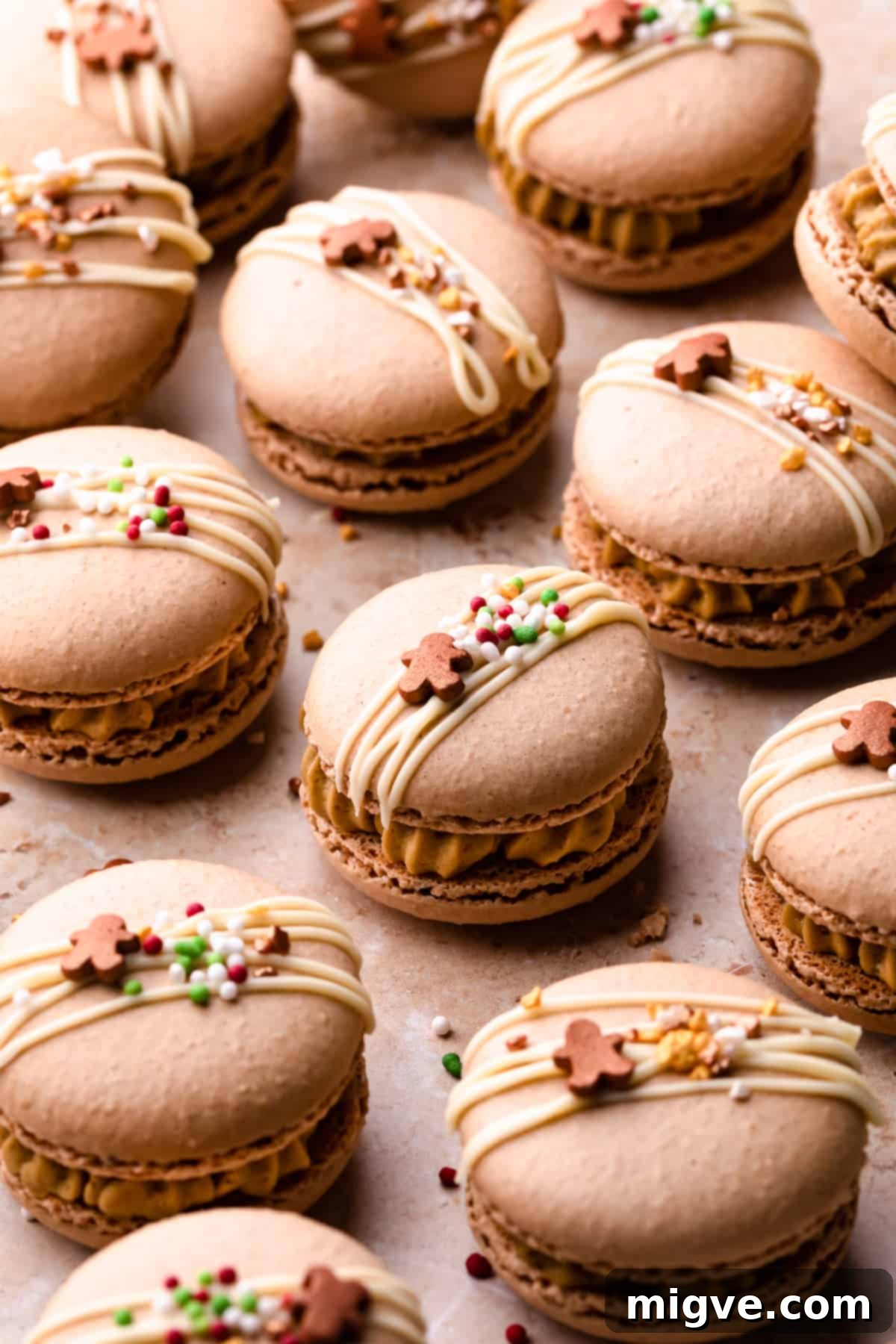
Don’t forget to pin this recipe to save it for your next baking adventure! Use the pin button on the recipe card below or on any of the beautiful photos above.
If you try this delightful gingerbread macaron recipe, or any other recipe from Anna Banana, please take a moment to rate it and/ or leave a comment. Your feedback is invaluable to me and helps other bakers who are considering making the recipe!
📖 Recipe

Print Recipe
Pin Recipe
Gingerbread Macarons
Equipment
- Digital kitchen scales
- Oven thermometer
- Electric mixer (hand-held or freestanding with whisk attachment)
- 2 large baking trays
- Baking paper or silicone baking mats
- Mixing bowls (glass or metal)
- Disposable or reusable piping bags
- Large plain piping nozzle
Ingredients
For the macaron shells:
- 110 g egg whites room temperature
- 110 g caster sugar
- 115 g almond flour
- 115 g icing sugar sifted
- ¼ teaspoon ground ginger
- ¼ teaspoon ground cinnamon
- ¼ tsp ground nutmeg
- 1 teaspoon cocoa powder
For the filling:
- 70 g unsalted butter
- 150 g icing sugar sifted
- 2 teaspoon molasses or black treacle
- ¼ teaspoon ground ginger
- ¼ teaspoon ground cinnamon
- ¼ teaspoon ground nutmeg
- 1 tablespoon milk optional
- 100 g white chocolate, melted optional
- 2 tablespoon festive sprinkles optional
Instructions
To make the macaron shells:
- Sift the almond flour and icing sugar together, disposing of any large particles remaining on the sieve. Next, sift the almond flour, icing sugar, spices and cocoa powder together into a large bowl. Set aside.115 g almond flour, 115 g icing sugar, ¼ teaspoon ground ginger, ¼ teaspoon ground cinnamon, ¼ teaspoon ground nutmeg, 1 teaspoon cocoa powder
- Place the egg whites into a bowl of an electric mixer fitted with the whisk attachment. Beat the egg whites until soft peaks, about 2 minutes. Gradually, start adding the caster sugar, 1-2 tablespoons at a time, and continue to beat until stiff peaks form. The peaks should be pointing straight up when you lift the whisk, rather than bending to the side.110 g egg whites, 110 g caster sugar
- Tip half of the dry ingredients into the meringue, and using a figure-of-eight motion, fold in gently with rubber spatula or metal spoon, until combined. Add the remaining half and fold again until combined and glossy.
- You should stop folding the batter when it is glossy, and has thick, flowing consistency (like honey). The batter is ready when you can draw a figure of ‘8’ with the batter before it breaks. If you can’t, keep folding the batter, and checking often, as you don’t want to over-mix it. 3-4 folds at a time is what you should be aiming for.
- Transfer the batter into piping bag with large plain nozzle. Hold the bag vertically to the baking tray, with the nozzle about 1 cm above it. Apply a gentle pressure and carefully pipe rounds, about 2.5 cm in diameter, for about 3-5 seconds, then quickly pull the piping bag up, twisting slightly at the top.
- Once you have piped all of the batter, tap the baking trays against the kitchen surface 3-4 times to release any air bubbles that formed in the batter. Use a toothpick to pop any air bubbles that are visible on the surface of macarons shells.
- Let the piped macarons sit at room temperature for 30 minutes- 1 hour, or until they have developed skin. They are ready when you touch them gently and they feel dry.
- Heat the oven to 160°C (320°F). Bake one tray at a time for 12-15 minutes. As the macaron shells bake, they should form feet. They are done when they do not move on their ‘feet’ when touched.
- Remove the tray from the oven and let the shells cool completely on the baking sheet, before gently peeling them off. The shells are ready to fill and sandwich together.
To make the gingerbread buttercream:
- Place the butter into a bowl of an electric mixer. With the mixer running on medium speed, cream the butter for a couple of minutes, until smooth, pale and fluffy.70 g unsalted butter
- Add the icing sugar in two additions (to avoid a cloud of sugar eruption), and mix well on a low speed, until combined. Add the molasses and the spices, and mix again to combine. If the frosting feels too dry, add 1 tablespoon of milk. If it feels too thin or is too runny, add a bit more icing sugar. Your buttercream should have a smooth, creamy and firm consistency.150 g icing sugar, 2 teaspoon molasses or black treacle, ¼ teaspoon ground ginger, ¼ teaspoon ground cinnamon, ¼ teaspoon ground nutmeg, 1 tablespoon milk
- Transfer the buttercream into a piping bag fitted with your chosen nozzle (you can use the same nozzle that you used to pipe the macaron shells with for convenience).
To assemble the macarons:
- Match up macaron shells that are similar in size to form pairs. Turn one side of each pair over so the flat side is facing up.
- Drizzle the melted white chocolate on top of half of the shells (the right-side up ones). Immediately add festive sprinkles on top of the chocolate drizzle before it sets.100 g white chocolate, melted, 2 tablespoon festive sprinkles
- Pipe the gingerbread frosting onto the remaining half of the shells (the inverted ones). Gently place the decorated shell on top of the piped frosting, pressing lightly to sandwich them together.
- Transfer the assembled gingerbread macarons into an airtight container or box, and place in the fridge for 12-24 hours, allowing them to mature. Serve at room temperature for the best flavor and texture.
Please note that all my recipes are developed and tested using metric grams. I highly recommend using digital kitchen scales for the most accurate and consistent results. While a conversion to US customary units is provided in the recipe, please be aware that I have not personally tested the recipe using these converted measurements.
Notes
Prepare the baking trays, wipe the mixing bowls with lemon juice or vinegar, measure all of the ingredients, prepare the piping bags.
Sift the almond flour and icing sugar at least once or twice. This will ensure your macarons have smooth, grain-free surface.
Substitutes:
- I do not recommend substituting any of the core ingredients in the macaron shells recipe (you can, however, use different spices or combinations of spices).
- Do not use egg whites from a carton/box for macarons. Fresh egg whites are essential.
Storage:
Store assembled macarons in an airtight container at room temperature for up to 2 days, or in the fridge for up to 5 days.
Macaron shells, as well as finished macarons, can also be frozen for up to a month. Thaw them at room temperature before filling or serving.
Buttercream can be made in advance and stored in the fridge for up to a week. You may have to re-whip it briefly before using for the filling.