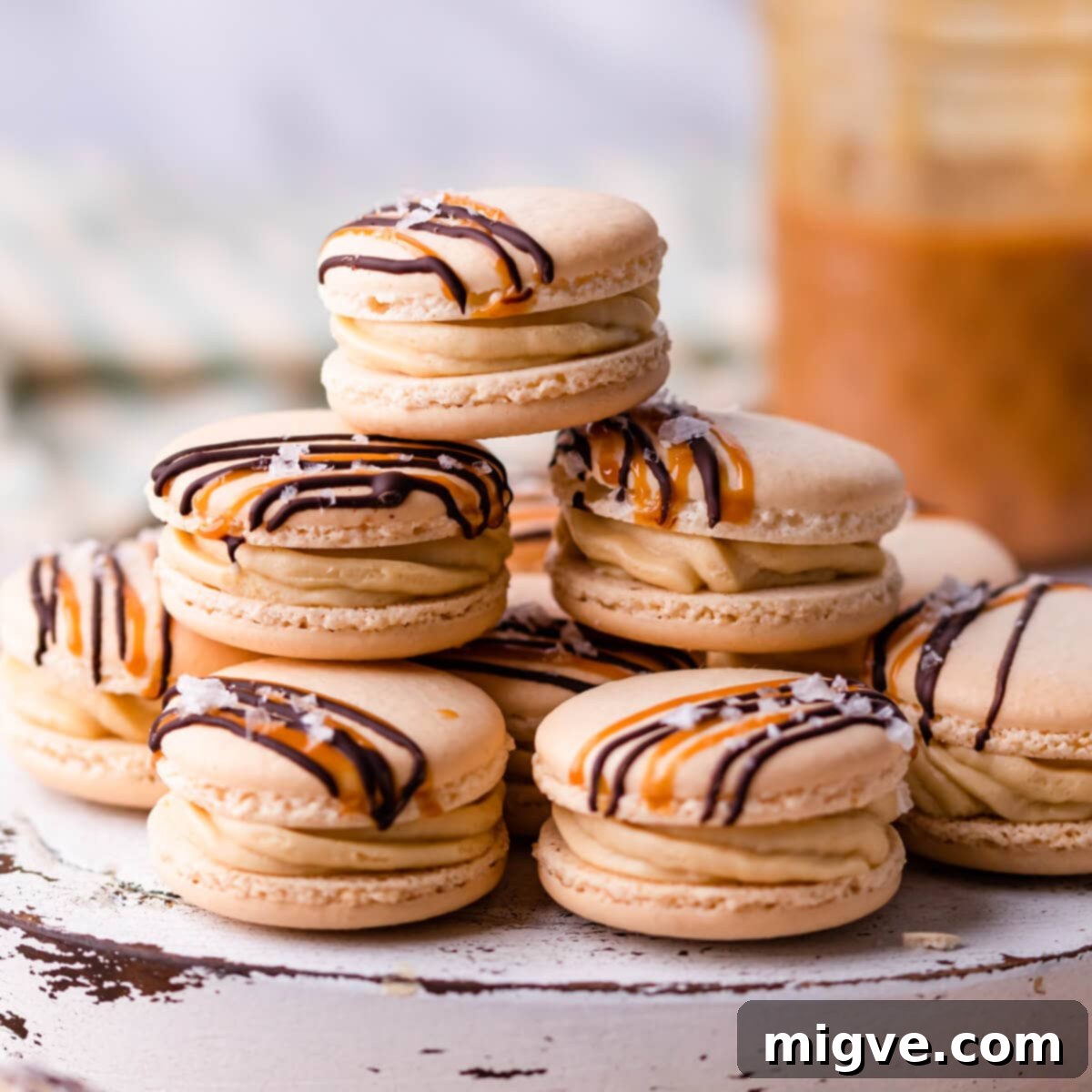
Indulge in the exquisite pleasure of homemade Salted Caramel Macarons, a truly elegant and utterly irresistible dessert that promises a symphony of textures and flavors. These delicate French confections feature perfectly crisp macaron shells, a luscious salted caramel Swiss meringue buttercream, and a delightful hidden pool of rich salted caramel nestled within their creamy center. Each exquisite macaron is then artfully adorned with a delicate drizzle of more caramel, a hint of dark chocolate, and a sprinkle of flaky sea salt, culminating in the ultimate sweet and salty culinary experience that will captivate your palate.
From their distinctively crunchy exterior to their wonderfully soft and chewy interior, every bite offers a harmonious blend of textures. The luxurious, buttery Swiss meringue buttercream, infused with the deep notes of salted caramel, complements the almond shells flawlessly. These decadent caramel macarons are designed to be love at first bite, transforming any ordinary moment into a special occasion.

Macarons possess an unparalleled charm, making them a fantastic treat to enjoy and share throughout the year, suitable for any gathering or celebration. Their inherent beauty, sophisticated elegance, and undeniable deliciousness make them universally adored. These homemade salted caramel macarons are also a thoughtful and impressive gift for loved ones, especially during the festive season or for any special milestone. Imagine gifting a beautifully packaged box of these artisanal treats – it’s a gesture sure to be remembered.
Should you be seeking further inspiration for delightful edible gifts to share with friends and family, explore our collection of other beloved recipes. You might enjoy creating our Danish Butter Cookies, savor the unique crunch of Lemon and Pistachio Biscotti, or indulge in the rich sweetness of our Dulce De Leche Stuffed Cookies. Each of these recipes makes for wonderful and delicious presents for Christmas, birthdays, or any occasion beyond.
For those eager to dive straight into baking, navigate to the full recipe card at the bottom of this page for a comprehensive ingredient list and detailed instructions.
Essential Ingredients for Salted Caramel Macarons
Crafting perfect macarons starts with understanding the role of each ingredient. For the delicate and airy macaron shells, you will require a few fundamental components, each contributing to their signature texture and appearance:

- Egg Whites: The backbone of the meringue, which forms the macaron’s structure. Using room temperature egg whites is crucial, as they whip up to a greater volume and create a more stable meringue. This stability is key to achieving those coveted “feet.”
- Granulated or Caster Sugar: This sugar is essential not only for sweetness but also for stabilizing the egg whites, transforming them into a firm, glossy meringue that holds its shape. Fine caster sugar dissolves more easily, contributing to a smoother shell.
- Ground Almonds or Almond Flour: The primary dry ingredient that gives macarons their distinctive soft, chewy texture. For the smoothest shells, it’s vital to use finely ground almond flour. If using ground almonds, ensure they are blanched and finely processed to avoid a gritty texture.
- Icing Sugar (Powdered Sugar): This fine sugar plays a dual role. It helps absorb moisture from the macaron batter, contributing to the crispness of the shell, and it is largely responsible for the development of the characteristic ruffled “feet” at the base of each macaron.
For the luxurious filling, we’ll be preparing a silky Swiss meringue buttercream, generously flavored with exquisite salted caramel. This type of buttercream is renowned for its smooth texture, rich flavor, and less cloyingly sweet profile compared to traditional buttercreams. Here’s what you’ll need to create this indulgent filling:

- Egg Whites: Used to create the meringue base for the buttercream, giving it a light and airy yet stable consistency.
- Granulated or Caster Sugar: Combined with egg whites and gently heated to form a stable meringue, which is the foundation of Swiss meringue buttercream.
- Unsalted Butter: Softened but still cool, this is gradually incorporated into the meringue to create a rich, creamy, and smooth buttercream.
- Salted Caramel: The star flavor, providing a deep, sweet-and-salty depth to the buttercream.
- Vanilla Extract: Enhances the overall flavor profile, adding a warm, aromatic note.
- Salt: A touch of extra salt helps to balance the sweetness and amplify the caramel flavor, crucial for a truly “salted” caramel experience.
Remember, precision is paramount in macaron making. Always measure your ingredients with a digital kitchen scale for the most consistent and successful results.
Crafting Your Salted Caramel Macarons: Step-by-Step Guide
While macarons have a reputation for being challenging, with patience and attention to detail, they are remarkably achievable. Many bakers find it helpful to watch a video tutorial for visual guidance, especially for critical steps like meringue consistency and macaronage. Although not directly included here, seeking out such resources can greatly enhance your success.
While the order of preparation is flexible, some bakers prefer to start with the filling. However, for a beginner, focusing on perfecting the macaron shells first can be beneficial. Macarons are often deemed “fussy” or “difficult,” but this perception often stems from a lack of understanding of key techniques. I believe that success comes from trying, experimenting, and truly understanding the nuances of the recipe. Once you master the fundamentals, baking these delightful treats will become a joyous routine!

Prepare the Dry Ingredients: Begin by sifting your ground almonds (or almond flour) and icing sugar together into a bowl. This step is crucial for achieving smooth macaron shells, free from bumps. Discard any larger particles that remain in the sieve. For an exceptionally fine texture, especially if using standard ground almonds, sift this mixture twice. Set aside.

Create the Meringue: In a clean, grease-free bowl (this is paramount for successful meringue), begin whipping your room-temperature egg whites until soft peaks form. Gradually add the granulated or caster sugar, a tablespoon at a time, continuing to beat until the meringue reaches stiff, glossy peaks. When you lift the whisk, the peaks should stand upright without bending. This stable meringue is the backbone of your macaron shells.
Expert Tip for Superfine Texture: Using a fine mesh kitchen sieve to sift your almond flour and icing sugar is non-negotiable. Sifting twice ensures you eliminate all larger grains and almond particles, which prevents your macarons from having a gritty or bumpy surface. This meticulous step is key to achieving that smooth, elegant finish.
Creative Use for Leftovers: Don’t let any leftover almond flour go to waste! It’s fantastic for adding a delicate texture to other baked goods. Consider using it to make these delicious almond flour waffles, offering another delightful way to enjoy its nutty flavor.

The Art of Macaronage: Gently fold the sifted almond and icing sugar mixture into your stiff meringue in two additions. The goal is to deflate the meringue just enough to create a shiny, glossy batter that flows in a thick ribbon from your spatula. A classic test for readiness is the “figure 8” test: you should be able to lift your spatula and “draw” a continuous figure 8 with the batter as it falls, without it breaking. This indicates the perfect consistency for piping.

Piping and Resting: Transfer the prepared macaron batter into a piping bag fitted with a large, round nozzle. Pipe uniform rounds onto baking sheets lined with parchment paper or silicone mats (templates can be very helpful here for consistency). After piping, firmly tap the baking trays several times against your kitchen surface to release any trapped air bubbles. Use a toothpick to gently pop any visible surface bubbles. Then, allow the piped macarons to “rest” at room temperature until a dry skin forms on their surface. This resting period is critical for developing the signature “feet” during baking.
Critical Macaronage Hint: It’s always safer to slightly under-mix your batter than to over-mix it. The batter should fall into the bowl in a slow, thick, ribbon-like consistency. When the ribbon falls, it should smoothly reincorporate into the batter within approximately 20 seconds. If it takes longer, continue folding the batter gently for 3-4 additional strokes at a time, then re-test. Over-mixing will result in runny batter and flat macarons.

Assembling Your Salted Caramel Macarons
Once your macaron shells are baked to perfection and completely cooled, the exciting part begins: assembly! This is where your individual shells transform into complete, delectable salted caramel macarons. Exercise gentleness during this stage, as the baked shells are delicate. When peeling them from the baking paper or silicone mats, proceed slowly and carefully to prevent breakage.

Matching the Shells: Carefully lay out all your baked macaron shells. Begin the process of matching similar-sized shells with each other to create pairs. Organize them into two rows: one row for the designated ‘top’ shells and another row with the flat side facing upwards for the ‘bottom’ shells. This organized approach simplifies the assembly line.

Decorating the Tops: Prepare your melted chocolate and additional salted caramel by placing them into separate piping bags (or using small spoons for drizzling). Drizzle the melted chocolate artistically over the top shells, followed by a generous drizzle of salted caramel. Finish these decorated tops with a delicate sprinkle of sea salt flakes, which not only adds visual appeal but also enhances the sweet-and-salty flavor profile.

Filling the Bottoms: Take each matched bottom shell, with its flat side facing up. Using a piping bag fitted with a decorative nozzle, pipe a neat border of your prepared salted caramel Swiss meringue buttercream around the edge. In the empty center, pipe a small, enticing pool of extra salted caramel, ensuring a delightful burst of liquid caramel with every bite.

Bringing It All Together: Carefully place each decorated top shell onto its corresponding filled bottom shell. Press very gently to sandwich the two halves together, ensuring the filling spreads just to the edges without oozing out excessively. Your gorgeous salted caramel macarons are now assembled and ready for their final crucial step.
Enhancement Hint for Flavor: For the absolute best flavor experience, allow your assembled macarons to “mature” in the fridge overnight. This resting period allows the filling to soften the shell slightly and for the flavors to meld and deepen to their full potential. Before serving, always bring them back to room temperature for the perfect melt-in-your-mouth texture.
Thoughtful Substitutions and Adaptations
In the intricate world of macaron baking, precision is often hailed as king. Adhering to exact measurements and meticulously following each step of the recipe is crucial, as even minor alterations can significantly impact the final texture and appearance. However, with careful consideration, a few thoughtful substitutions can be explored in this salted caramel macaron recipe without compromising too much on quality. Always remember that any change may alter the final result, so proceed with a spirit of experimentation.
- Sugar in Shells: While superfine caster sugar is ideal due to its rapid dissolving properties, regular granulated sugar can be used as an alternative. Ensure it is fully dissolved into the egg whites during meringue formation to prevent a grainy texture. The finer the sugar, the smoother your macaron shells will be.
- Ground Almonds vs. Almond Flour: In many regions, “ground almonds” are blanched but not as finely milled as specialized “almond flour.” If using ground almonds, it is imperative to sift them thoroughly, ideally twice, through a very fine kitchen sieve. This removes any larger particles, which are the primary culprits behind bumpy, uneven macaron shells. The goal is a super-fine texture for that signature smooth finish.
- Egg Whites for Meringue: For my macaron recipes, similar to my Pavlova recipe, I consistently prefer fresh egg whites. While some traditional methods advocate for “aged” egg whites (left at room temperature for a day or two), I find fresh ones yield equally stable and reliable meringues. If you prefer convenience, carton egg whites can be used, but in my personal experience, they often produce a less stable meringue, which can be challenging for macaron beginners.
- Salted Caramel Swiss Meringue Buttercream Alternatives: If Swiss meringue buttercream seems too daunting, or you simply prefer a different filling, feel free to substitute. A classic chocolate ganache (the one from my Chocolate Thumbprint Cookies recipe works wonderfully) or a simple American-style buttercream are excellent options. For an easier salted caramel buttercream, you can whip together 100g of room-temperature unsalted butter with 150g of icing/powdered sugar and 60g of store-bought salted caramel sauce until light, fluffy, and creamy.
- Salted Caramel Source: To simplify, this recipe calls for ready-made, shop-bought salted caramel. I’ve also had excellent results using tinned caramel fillings, such as Carnation caramel. Should you have the time and inclination, homemade salted caramel will undoubtedly elevate the flavor to another level, offering a deeper, more nuanced taste.

Creative Variations for Your Macarons
While the salted caramel macaron is a classic for a reason, the beauty of macarons lies in their versatility. Once you’ve mastered the basic shell, a world of creative possibilities opens up. Here are some delightful variations to inspire your next batch:
- Vibrant Food Colouring: Macarons are renowned for their beautiful array of colors. To achieve stunning hues without affecting the batter’s delicate consistency, always opt for gel food coloring. Only a tiny amount is needed; simply use a toothpick to incorporate it into your meringue during the whipping stage, creating pastel or vibrant shades to match any theme or mood. For example, consider these eye-catching Birthday Cake Macarons for inspiration.
- Eggless Macarons: For those with dietary restrictions or simply seeking an alternative, eggless macaron recipes offer a fantastic solution. These recipes often utilize aquafaba (chickpea brine) or other plant-based proteins to create a stable meringue. Explore this excellent eggless macaron recipe from Bake with Shivesh blog for a successful plant-based option.
- Diverse Filling Flavors: If salted caramel isn’t your only passion, the filling is an easy component to customize.
- Chocolate Ganache: A rich, decadent chocolate ganache provides a classic contrast to the light macaron shell. The ganache recipe from our Chocolate Thumbprint Cookies would be perfect here.
- Fruity Buttercreams: Explore vibrant fruit-flavored buttercreams. Raspberry buttercream offers a tart and sweet balance, while a delicate vanilla buttercream is a timeless choice.
- Lemon Curd: For a bright and zesty twist, homemade lemon curd makes an incredibly refreshing and delicious filling, offering a tangy counterpoint to the sweet shells.
- Exciting Add-ons and Decorations: Don’t limit your creativity to just the filling. Experiment with various add-ons and decorations to personalize your macarons:
- Nuts: Finely chopped pistachios, hazelnuts, or pecans can be sprinkled on top of the shells before baking or incorporated into the filling for added crunch and flavor.
- Sprinkles: For a festive touch, decorative sprinkles can be added to the wet shells before drying.
- Spreads and Jams: Swirl in small amounts of fruit jams, Nutella, or even peanut butter into your buttercream for an unexpected flavor combination.
Essential Equipment for Macaron Success
Baking macarons, while a precise art, doesn’t require an overwhelming amount of specialized kitchen equipment. However, a few key tools are genuinely indispensable for achieving consistent and beautiful results. Investing in these items will significantly contribute to your macaron-making success:
- Digital Kitchen Scales: This is arguably the most crucial piece of equipment for macarons. Precision in measurements is non-negotiable for this recipe. Digital scales ensure accuracy, which is far superior to volumetric cup measurements when dealing with delicate batters.
- Baking Trays/Baking Sheets: This recipe typically yields a substantial batch (30-40 macarons), so having at least two large, sturdy baking sheets on hand is highly recommended. This allows for efficient baking in batches.
- Baking Paper or Silicone Baking Mats: To prevent sticking and aid in easy removal, line your baking sheets. If using parchment paper, you might find it helpful to draw uniform round templates underneath to guide your piping and ensure consistent macaron size and shape. My personal preference, and a highly recommended tool, are silicone baking mats that come pre-printed with macaron templates, making piping much simpler and more consistent.
- Piping Bag: Essential for neatly piping the macaron batter into uniform rounds. A good quality, reusable piping bag offers better control.
- Plain Round Piping Nozzle: A large, round piping nozzle (such as a Wilton 1A or a similar size) is ideal for piping macaron shells, ensuring smooth, even circles.
Additionally, for preparing the luxurious Swiss meringue buttercream and executing the decorative finishes, these items will prove invaluable:
- Freestanding Mixer with Paddle and Whisk Attachment: While it’s possible to make Swiss meringue buttercream with a hand-held mixer, a stand mixer significantly streamlines the process. The whisk attachment is used for creating the meringue, and the paddle attachment is then used for incorporating the butter to achieve a smooth buttercream. Its hands-free operation is a huge advantage.
- Kitchen Thermometer: An optional but highly recommended tool, especially for beginners making Swiss meringue buttercream. It helps ensure the egg whites and sugar mixture reaches the precise temperature (71°C/160°F) needed for safety and optimal meringue stability.
- Additional Piping Bags: For convenience and clean execution, I suggest having separate piping bags for each component: one for the buttercream, one for the salted caramel drizzle, and another for the melted chocolate. However, if you prefer, you can easily spread the filling with a palette knife or spoon, and use a spoon for drizzling the caramel and chocolate.
- Small Decorative Nozzle: Optional, but useful if you want to pipe an intricate border of buttercream onto your macarons. Choose your favorite type or shape to add a personal touch to the presentation.

Storage and Preparation Tips
Proper storage is key to maintaining the delicate texture and exquisite flavor of your homemade salted caramel macarons. These treats are best enjoyed when their flavors have had a chance to meld and deepen, a process often referred to as “maturing.”
Refrigerator Storage: Store your assembled salted caramel macarons in an airtight container in the fridge for up to 7 days. For optimal enjoyment, always allow them to come to room temperature for about 15-30 minutes before serving. This softens the filling and enhances the chewiness of the shell.
Freezing Macarons: For longer storage, macarons freeze beautifully. You can freeze either the baked macaron shells on their own or the fully assembled cookies for up to 2 months. To freeze, arrange them in a single layer in a large airtight container, separating layers with sheets of baking parchment to prevent sticking. When ready to enjoy, simply thaw them at room temperature. The texture of the shells and the creaminess of the filling will be wonderfully preserved.
Advance Preparation: Each component of this salted caramel macaron recipe can be conveniently prepared in advance, allowing for a stress-free assembly day.
- Macaron Shells: Bake the macaron shells up to two days ahead of time. Once completely cooled, store them in an airtight container at room temperature.
- Salted Caramel Swiss Meringue Buttercream: This buttercream holds up well in the fridge for up to 3 days. Before using, you may need to re-whip it with an electric mixer for a few minutes to restore its smooth, creamy consistency.
- Salted Caramel Sauce: Any leftover salted caramel can be stored in an airtight jar in the fridge for several weeks or frozen for up to 3 months.
- Freezing Buttercream: The Swiss meringue buttercream itself is also suitable for freezing for up to 3 months. Transfer it to an airtight container before freezing. When ready to use, thaw it overnight in the fridge, then transfer it to the bowl of an electric mixer and whip on medium speed for 2-3 minutes until it becomes light and creamy again.

Top Tips for Macaron Mastery
Mastering macarons boils down to understanding and executing three crucial stages with precision: the meringue, the macaronage (folding of the batter), and the drying of the shells. Once you grasp these fundamental principles and dedicate extra care during each step, you will undoubtedly become a macaron expert in no time!
- The Perfect Meringue: The meringue forms the very foundation and structure of your macaron cookie. It is imperative that your mixing bowl and whisk are impeccably clean and completely grease-free, as even a tiny speck of fat can prevent the egg whites from whipping properly. Whip the meringue until it forms firm, stiff peaks. When you lift the whisk, the peaks should stand straight upwards, proudly defying gravity, rather than flopping to the side. This stability is critical for the macaron’s rise and structure.
- Flawless Macaronage (Folding the Batter): This stage is arguably the most challenging to master, especially for first-time macaron bakers, as it’s incredibly easy to either over-mix or under-mix the batter. The consistency of your batter at this point will directly determine the shape, texture, and ultimate appearance of your macaron shells. You are aiming for a lava-like consistency, where the batter flows slowly and smoothly off the spatula in a continuous ribbon. It should be able to form a “figure 8” without breaking. While a video is highly recommended for visual guidance, remember that gentle, deliberate folding is key to achieving this perfect balance.
- The Crucial Drying of the Shells (Maturing): This often-overlooked yet vital stage ensures that your macarons develop their characteristic “feet” – that beautiful ruffled edge at the bottom of the cookie. The time required for the shells to dry and develop a “skin” can vary significantly based on environmental factors like air temperature, humidity levels, and climate. It might take as little as 30 minutes on a dry day, or it could extend to 2-3 hours (or even longer in very humid conditions) before they are completely dry to the touch. When gently touched, the surface of the macaron should feel dry and not sticky. Be patient during this stage; waiting it out will be entirely worth it for those perfect feet!

Frequently Asked Questions About Macarons
Cracking is one of the most common issues faced by macaron bakers, and several factors can contribute to it. The primary culprits are often an oven that is too hot, meringue that has been over-mixed trapping too many air bubbles, or macaron batter that was under-mixed. To troubleshoot, always use an oven thermometer to ensure accurate temperature and consider baking a small test batch first to find the “sweet spot” for your specific oven, as temperatures can vary significantly. Stop mixing your meringue as soon as it reaches stiff peaks to avoid over-aeration, and meticulously fold your macaron batter until it achieves the correct, flowing consistency.
The absence of characteristic “feet” is usually an indication that your macaron batter was too wet, or more commonly, that you didn’t allow the piped macarons to “mature” or dry out adequately before baking. The resting period is crucial for forming a dry skin on the surface. This skin allows the macaron to rise and push the batter outwards, creating the ruffled feet. If the surface is still sticky or tacky, the steam generated during baking won’t have a firm surface to push against, leading to flat bottoms.
If your macarons aren’t rising, it often points back to issues with the meringue or the oven temperature. If the egg whites were not whipped correctly to stiff peaks, or if they lost their volume and stability during the macaronage (folding) process, the batter won’t have the necessary structure to lift. Additionally, an oven that isn’t hot enough will prevent the air bubbles in the meringue from expanding rapidly and lifting the shells to create that desirable rise. Ensure your oven is preheated properly and consider checking its temperature with a thermometer.

To easily bookmark this irresistible recipe and save it for future baking adventures, use the save button typically found on recipe cards or within the image galleries above!
We love to hear from our community! If you try this recipe, or any other creation from Anna Banana, please take a moment to rate the recipe and/or share your thoughts in a comment below. Your feedback not only delights us but also genuinely assists other home bakers considering trying the recipe.
📖 Salted Caramel Macaron Recipe

Print Recipe
Pin Recipe
Salted Caramel Macarons
Equipment
- Digital kitchen scales
- Baking trays (2 large)
- Baking paper or silicone baking mats (with macaron templates preferred)
- Piping bags (several, for batter, buttercream, caramel, chocolate)
- Plain round piping nozzle (large, e.g., Wilton 1A)
- Freestanding mixer with paddle and whisk attachment (recommended for Swiss meringue buttercream)
- Kitchen thermometer (optional, for Swiss meringue buttercream)
- Small decorative nozzle (optional, for buttercream border)
Ingredients
For the macaron shells:
- 110 g egg whites (from about 3 large eggs), room temperature
- 110 g caster or granulated sugar
- 115 g almond flour or finely ground almonds (sifted, see notes)
- 115 g icing/powdered sugar (sifted)
For the salted caramel Swiss meringue buttercream:
- 2 large egg whites
- 100 g caster or granulated sugar
- 140 g unsalted butter, softened but still cool and cut into smaller cubes
- 60 g salted caramel (homemade or shop-bought)
- 1 tsp vanilla extract
- ½ tsp salt
For decorating and hidden caramel:
- 50 g dark or milk chocolate, melted
- 50 g salted caramel (for the center and drizzle)
- 1 tbsp sea salt flakes
Instructions
To make macaron shells:
- Line two baking trays with baking paper or silicone baking mats. If using plain baking paper, you may wish to draw 2.5cm round templates underneath as a guide.
- Sift the almond flour/ground almonds and icing sugar together into a bowl. Discard any larger particles that remain in the sieve. For the smoothest shells, especially with ground almonds, sift the mixture twice. Set this mixture aside.
- In a scrupulously clean bowl of a standing mixer fitted with the whisk attachment (or using a hand-held mixer), beat the 110g egg whites until soft peaks form. Gradually add the 110g caster or granulated sugar, 1-2 tablespoons at a time, continuing to beat until the meringue forms stiff, glossy peaks that point straight up when the whisk is lifted.
- Add the sifted icing sugar and ground almonds mixture into the stiff meringue in two additions. Begin the macaronage process by gently folding the batter. Scrape around the bowl and fold down through the center. Once all the dry mixture is incorporated, continue to press the batter against the sides of the bowl with your spatula, then fold it back into the center.
- Stop folding when the batter appears glossy and has a thick, flowing consistency. A good test is the “figure 8” method: you should be able to draw a continuous figure 8 with the batter as it drips off the spatula without it breaking. If it breaks, continue folding for 3-4 more strokes at a time, then re-test. It’s better to slightly under-mix than over-mix. The batter should also smoothly reincorporate into itself within about 20 seconds.
- Transfer the macaron batter into a piping bag fitted with a large, plain round nozzle. Hold the bag vertically, about 1 cm above the prepared baking tray. Apply gentle, steady pressure to pipe uniform rounds (approximately 2.5cm in diameter) for about 3 seconds, then quickly pull the piping bag up with a slight twist.
- Once all the batter is piped, firmly tap the baking trays against your kitchen counter several times. This releases any trapped air bubbles within the batter. Use a toothpick to gently pop any visible air bubbles on the surface of the macaron shells.
- Allow the trays with piped macarons to rest at room temperature for 1-2 hours, or until a dry “skin” has formed on their surface. When you gently touch a macaron, it should feel dry and non-sticky. This resting period is crucial for the development of “feet.”
- Preheat your oven to 150°C (300°F). Bake one tray at a time for approximately 10-15 minutes, rotating the tray halfway through to ensure even baking and browning. Baked macarons should develop distinct “feet” and appear slightly deeper in color. To test for doneness, gently wiggle the tray; the macarons should not move. If they jiggle, bake for a few more minutes.
- Remove the baked tray from the oven and allow the macaron shells to cool completely on the tray before attempting to gently peel them off the baking paper or mat. Removing them too soon can cause them to tear.
To make salted caramel Swiss meringue buttercream:
- In a heatproof bowl, whisk the 2 large egg whites and 100g sugar together. Place the bowl over a saucepan with gently simmering water over medium heat, ensuring the bottom of the bowl does not touch the water. Continuously whisk the mixture (either by hand or with a hand-held mixer) for about 5 minutes, until all the sugar has completely dissolved and the mixture is frothy and foamy. You can test for dissolved sugar by rubbing a small amount between your fingers; it should feel smooth. Alternatively, use a kitchen thermometer to ensure the mixture reaches 71°C (160°F).
- Carefully transfer the hot meringue mixture to the bowl of a standing mixer fitted with the whisk attachment. Beat on medium-high speed until the meringue becomes glossy, forms stiff peaks, and is completely cool to the touch. This cooling process can take a while, sometimes up to 20 minutes, depending on the ambient humidity. Patience here is essential.
- Once the meringue is cool and at stiff peaks, switch to the paddle attachment. Gradually add the 140g softened (but still cool) unsalted butter, one small cube at a time, beating well after each addition until fully incorporated. Initially, the mixture might look curdled or separated, but keep mixing; it will eventually come together into a thick, creamy, and smooth buttercream. If it still appears thin, place the bowl in the fridge for 10-15 minutes, then whip it again.
- Finally, add the 60g salted caramel, 1 teaspoon vanilla extract, and ½ teaspoon salt to the buttercream. Whisk on low speed until everything is well combined and uniformly flavored. Transfer this delicious buttercream into a piping bag, ideally fitted with your decorative nozzle of choice.
To assemble the macarons:
- Match similar-sized macaron shells to create pairs. Prepare the 50g melted chocolate and the additional 50g salted caramel by placing them into separate small piping bags (or using spoons). Snip off tiny ends of the piping bags. Drizzle some melted chocolate over one half of your matched shells (these will be the tops), then drizzle with salted caramel. Immediately sprinkle the 1 tablespoon of flaky sea salt on top of each decorated shell.
- Take the other half of your matched shells (the bottoms). Pipe a neat ring of the salted caramel buttercream around the edges of the flat side of each bottom shell. Then, pipe a small amount of the extra salted caramel (from the 50g reserved for decorating) into the center of each buttercream ring, creating a delightful caramel pool.
- Carefully place the decorated top shells over the filled bottom shells and press very gently to sandwich them together. Be careful not to press too hard, as the shells are delicate.
- While you can enjoy your freshly assembled macarons right away, for the best flavor development, we highly recommend storing them in an airtight container in the fridge overnight. This “maturing” process allows the filling to soften the shells and the flavors to meld beautifully. Remember to bring them to room temperature before serving for the optimal taste and texture. Enjoy your exquisite homemade salted caramel macarons!
Please note that all my recipes are developed and tested using metric grams for the highest accuracy. I strongly recommend using digital kitchen scales for precise measurements. While a conversion to US customary units is provided in the recipe, please be aware that I have not personally tested the recipe using these conversions, and results may vary.
Video
While this written guide provides comprehensive steps, watching a visual demonstration can be incredibly helpful for macaron techniques. Search for “Salted Caramel Macarons tutorial” on your preferred video platform to see key steps like meringue whipping, macaronage, and piping in action. A visual aid often clarifies subtle nuances that are hard to describe in text alone.
Baker’s Notes
- Oven Temperature is Key: Many macaron recipes suggest baking at higher temperatures, like 163°C (325°F). However, in my fan-assisted oven, this often leads to cracked shells. I’ve found that 150°C (300°F) works perfectly for me. Oven temperatures vary significantly, so you may need to experiment to find your oven’s “sweet spot.” Always bake a small test batch first to determine the ideal temperature for your equipment.
- Even Baking: For consistent results and beautifully browned macarons, always bake one tray at a time. Rotate the baking tray halfway through the baking time to ensure even heat distribution.
- Adjust Baking Times for Size: The indicated baking times are for 2.5cm (1-inch) macarons. If you pipe smaller shells, reduce the baking time by a couple of minutes. For larger shells, you might need to add a few more minutes to ensure they are fully baked.
- Testing for Doneness: To check if your macarons are ready, gently touch a macaron shell with your finger or a spoon. If it feels wobbly or jiggly, it’s not done and requires a few more minutes in the oven (check every 2 minutes). You want them to be stable and not move when gently touched.
- Cool Completely Before Removal: Resist the urge to peel your macarons off the baking parchment or silicone mat while they are still warm. They are very fragile when hot and attempting to remove them prematurely will likely cause them to rip apart. Allow them to cool entirely on the tray.
Storage:
Store assembled macarons in an airtight container in the fridge for up to 7 days. Serve them at room temperature for the best texture and flavor.
Freezing:
You can freeze baked macaron shells (unfilled) or fully assembled macarons for up to 2 months. To freeze, place them in an airtight container, separating layers with parchment paper. Thaw at room temperature before serving.